 Listicle
Are Branded Gym Wear Sales Worth It for Members?
Last Updated: November 5, 2026
Quick Summary
Selling branded gym wear to members can add a second income stream on top of memberships, and it turns members into walking promotion for your gym. The commercial case is strongest when you run it as a small, managed product line with a tight range and a small first order.
- Calculate landed cost per unit, gross margin and break-even quantity before ordering any product.
- A worked example: an £18 landed-cost hoodie retailed at £45 breaks even at 20 units.
- Start with a tight range of core items such as a hoodie, a T-shirt and leggings or shorts.
- Give your most engaged members early access to new pieces to build loyalty and gather feedback.
- Check the supplier's size curve and order one sample in each size before committing to stock.
Table of Contents
- Why Gyms Are Turning to Branded Gym Wear for Members
- Increasing Revenue Through Merchandise Sales
- Building Brand Awareness Beyond the Gym Walls
- Strengthening Member Loyalty, Community and Team Identity
- How to Sell Branded Merchandise at a Gym
- Gym Merchandise Ideas and Pricing Considerations
- Gym Apparel Sales Strategies and Your Next Step
- Frequently Asked Questions
Why Gyms Are Turning to Branded Gym Wear for Members
Branded gym wear gives a gym a product line it can sell straight to the people already walking through its doors. Gym owners often ask whether selling branded gym wear to members is worth the effort? The honest answer depends on how you run the sales, but the commercial logic is clear. Your members already trust your space, and they already want to look and feel like part of your community.
Many gym owners treat merchandise as an afterthought, a rack by the front desk with a few T-shirts. That approach rarely works well. Gyms that plan their range, price it with care and make the buying experience easy tend to do better with merchandise. Below, we cover the revenue case, the brand and community benefits, the practical steps for selling on site, and the pricing questions to settle before you order.
Increasing Revenue Through Merchandise Sales
Merchandise adds a second income stream on top of memberships. Membership fees are steady, but they only grow when you add members or raise prices. Apparel sales can grow with the community you already have, and they do not depend on new sign-ups. The commercial case is strongest when you treat apparel as a small, managed product line rather than a rack of impulse buys.
The difference between a merchandise line that pays for itself and one that ties up cash comes down to unit economics. Before you order, work through a simple calculation for each product:
- Landed cost per unit. Take the wholesale price, add inbound delivery, and add any decoration or branding cost. This is your true cost before the item sells.
- Retail price. Set it against what members already pay for comparable high-street gym wear, then check the gap between price and landed cost.
- Gross margin per unit. Retail price minus landed cost. A margin that covers payment processing, display space and the occasional markdown, not just the garment, is worth aiming for.
- Break-even quantity. Divide your total upfront spend (stock, delivery, any display or photography cost) by the gross margin per unit. That tells you how many units must sell before the line is profitable.
- Unsold-stock risk. Multiply the units you expect to remain unsold by the landed cost. If that figure is uncomfortable, reduce the first order or move the item to a preorder model.
A worked example makes the logic concrete. Suppose a hoodie has a landed cost of £18 and you retail it at £45. Gross margin is £27 per unit. If you spend £540 on the first order, delivery and a small display, break-even is 20 units. Anything above 20 is profit, but only if the stock actually sells. If half the order sits in a cupboard, the margin on the sold units has to absorb the cost of the rest.
This is why a tight range matters. A few strong products sell better than a crowded rack of options that nobody picks up. A core hoodie, T-shirt and legging or short can cover everyday demand, with seasonal drops used sparingly to give members a reason to buy again.
- Core items: a hoodie, a T-shirt and a pair of leggings or shorts
- Seasonal drops that give members a reason to buy again
- Pre-orders for bigger pieces, so you only buy stock you can sell
A common mistake is buying too much stock upfront. Start with a small first order, track what sells, and reorder the lines that move. This keeps cash tied up in stock to a minimum and gives you real sell-through data before you commit to a larger buy. Watch out: if you order deeply on a design nobody has asked for, the unsold-stock risk can wipe out the margin on everything else in the range.
The break-even logic for each product comes down to a few simple figures, shown below using the article's hoodie example.
| Figure | Example value | What it means |
|---|---|---|
| Landed cost per unit | £18 | Wholesale price plus delivery and decoration |
| Retail price | £45 | Set against comparable high-street gym wear |
| Gross margin per unit | £27 | Retail price minus landed cost |
| Upfront spend | £540 | Stock, delivery and a small display |
| Break-even quantity | 20 units | Units needed before the line is profitable |
| Unsold-stock risk | Half the order | Can absorb the margin on sold units |
Building Brand Awareness Beyond the Gym Walls
Every member wearing your logo on a run, at the supermarket or in a café is free advertising. Branded gym wear turns your members into walking promotion for your business, and it reaches people who have never set foot in your building.
This matters most for gyms in competitive areas. A recognisable logo helps people remember your name when they are choosing where to train. Word of mouth also tends to travel further when people can see the brand on someone they know.
Keep the design clean. Bold logos that are easy to read at a distance work better than busy graphics that blur into noise.
Strengthening Member Loyalty, Community and Team Identity
Wearing the same gear builds a sense of belonging. Members who wear the gym's clothing feel part of a team, and that feeling makes them more likely to stay. Retention can be one of the more valuable effects of merchandise, even when it is hard to measure directly.
This works especially well for classes and clubs. Matching hoodies for a running club or team T-shirts for a boot camp make the group feel like a unit.
Where to start: give your most engaged members first access to new pieces. Early access makes them feel valued and gives you useful feedback before a wider launch.
How to Sell Branded Merchandise at a Gym
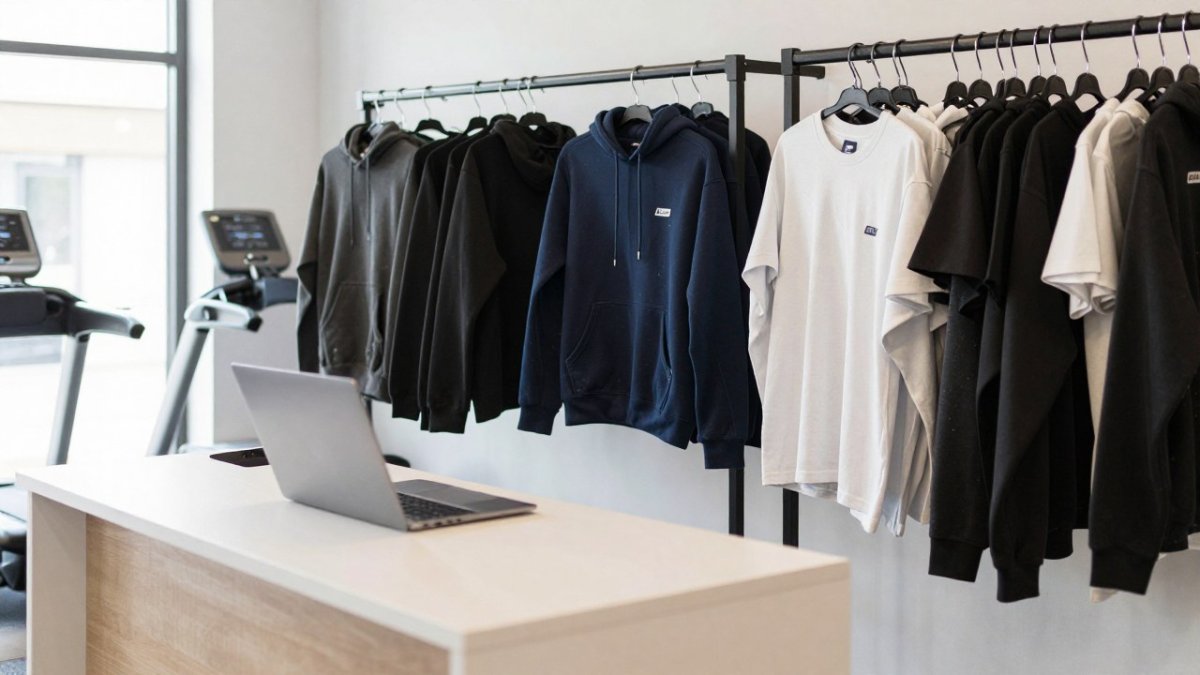
Selling on site works best when the process is simple. You need a clear display, a short product list and an easy way to pay.
- Choose a small range. Three to five products is enough to start.
- Display it well. Place the range near reception where members pass every visit.
- Test sizes. Keep a sample size on display so members can try before they buy.
- Offer online ordering. Many members prefer to order from their phone, especially for larger items.
- Promote it in your classes. A short mention at the end of a session can drive sales without a hard sell.
Watch out: a poor sizing range loses sales fast. If members cannot find their size, they will not buy. Check that your range covers a wide spread of sizes from the start.
Gym Merchandise Ideas and Pricing Considerations
The right products depend on what your members actually wear. A strong starting point is a mix of performance and lifestyle pieces, chosen for fit and fabric rather than logo placement alone.
- Team leggings: A high-waisted pair with a secure pocket is a popular choice for daily training. Check the size curve carefully, because leggings are the item most likely to be returned if the fit is inconsistent.
- Wicking T-shirts: Quick-dry fabric suits gym sessions, outdoor classes and everyday wear. Look for a fabric that holds its shape after repeated washing, not just one that feels soft on the first wear.
- Zip hoodies: Good for warm-ups and cool-downs, and easy to wear outside the gym. A mid-weight fabric tends to suit more of the year than a heavy fleece.
- Bags and accessories: Lower-cost items that let members buy in without a large spend.
Sizing and fit deserve more attention than they usually get. Ask for the supplier's size curve and compare it with your membership. If your community spans a wide range of body types, an inclusive size run reduces returns and makes more members feel the range is for them. Order one sample in each size before committing, and have staff or willing members try them on. Watch out: a poor sizing range loses sales fast, and a range that stops at a narrow band of sizes sends a clear message about who the clothing is for.
Quality is an important factor in whether members buy again. Fabric performance, stitching and colour-fastness matter, because a garment that fades or loses shape after a few washes can damage trust in the whole range. Ask suppliers about the materials and production standards behind each item.
Pricing needs the same care. Set prices that cover your landed cost, delivery and margin, then compare them with what members already pay for similar items on the high street. Pricing depends on order quantity, the garment you choose and your delivery option, so request a quote from REVIVE Activewear and Apparel for current figures rather than relying on estimates.
Before you commit to a range, validate demand rather than guessing. A short survey or a quick chat at the desk gives you real data on which items members would buy and at what price. Show two or three designs and ask members to choose, then run a preorder on the most popular piece. Preorders can help show whether demand is real before you spend on stock.
Finally, decide how you will fulfil orders. Stocked retail gives members immediate purchase but ties up cash. Preorder models can reduce upfront spend and unsold-stock risk but lengthen delivery times. Most gyms start with a small stocked range plus preorders for larger pieces, then adjust as sell-through data comes in.
Gym Apparel Sales Strategies and Your Next Step
The gyms that sell the most tend to treat merchandise as part of the member experience, not a side business. Keep the range focused, make sizing easy, and promote the pieces where members already spend time. Start small, watch what sells, and build from there.
Sign up for our email list to get updates on new ranges and ordering tips for gym owners.
Frequently Asked Questions
What are the benefits of selling branded gym wear to members?
Branded gym wear can add a steady additional income stream, raise the gym's visibility when members wear it outside the building, and help people feel part of a shared community. The benefits depend on how well the range fits your members, how it is priced and how you promote it, so start with a small range and test demand before committing to large stock orders.
How can gym merchandise increase a fitness club's revenue?
Merchandise adds a sales line alongside memberships and classes. Revenue grows when you sell items members actually want, such as hoodies, T-shirts, bags and water bottles, and when you promote them at the point of sale, at the front desk and through email. Track margin on each product after supplier costs and any returns, because a high-volume item with thin margin may add little profit.
How should a gym price its branded merchandise?
Price each item to cover the supplier cost, packaging, payment fees and any delivery charges, then add a margin that leaves room for profit. Compare your prices with the high street and with other gym shops so members see fair value. Pricing depends on quantity, the garment and the print, so request quotes from suppliers and check current costs on their websites before setting prices.
How can a gym avoid being left with unsold clothing stock?
Start with a small range of core items and use pre-orders or limited drops to measure demand before buying in bulk. Ask members which designs and sizes they want, and offer a good spread of sizes so fit does not put people off. Review sales every few weeks, reduce prices on slow lines and stop reordering items that do not sell.