 ultimate-guide
Bulk Activewear for Fitness Studios: 2026 Guide
Table of Contents
- Why Bulk Activewear Makes Commercial Sense for Fitness Studios
- Types of Gym Apparel Available for Bulk Order
- Custom Branded Fitness Apparel: Branding Options Compared
- Understanding Minimum Order Quantity for Gym Wear
- Private Label Activewear Suppliers: What to Look For
- Bulk Activewear Pricing, ROI and Inventory Management
- Legal and Compliance Considerations for Studio Merchandise
- Conclusion
Last Updated: August 12, 2026
Why Bulk Activewear Makes Commercial Sense for Fitness Studios
Fitness studio owners seeking revenue beyond membership fees find bulk activewear an effective solution. When you order gym apparel in volume, per-unit costs drop significantly, creating margin between wholesale and retail price. Studios that sell branded leggings, fitted tops, and compression gear turn every client wearing the kit into a walking advertisement.
Members who wear your studio's branded apparel develop stronger belonging and loyalty, translating into longer membership durations and higher referral rates. According to the British Retail Consortium's retail outlook reports, athleisure and performance apparel consistently rank among the fastest-growing segments in UK retail. Bulk orders also ensure consistent sizing across your team and professional presentation at events, signalling quality to prospective members.
Types of Gym Apparel Available for Bulk Order
Bulk gym apparel orders span core performance pieces to accessories. Understanding what's available helps you build a merchandise range that actually sells.
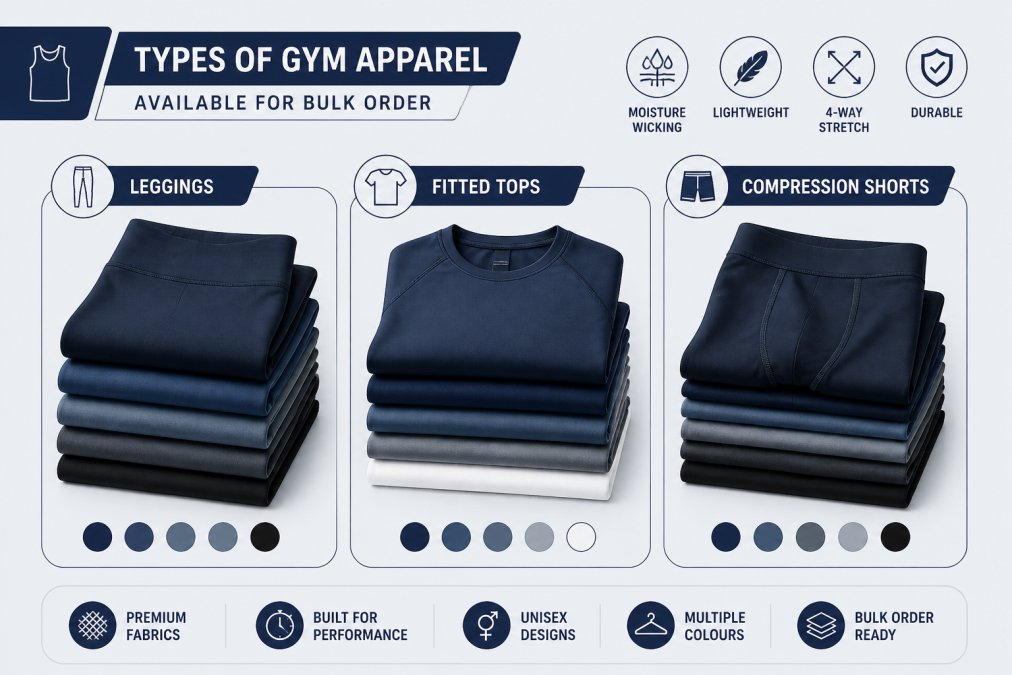
The most popular bulk categories for fitness studios include:
- Leggings and tights: High-waist styles with four-way stretch, available in full-length and cropped cuts
- Fitted and relaxed tops: Sports bras, tank tops, and short-sleeve tees in moisture-wicking fabrics
- Compression gear: Compression shorts, calf sleeves, and base layers for high-intensity training
- Mid-layers and zip-ups: Lightweight jackets and hoodies for warm-ups and post-class wear
- Shorts: Gym-ready training shorts with internal liners or compression shorts for functional movement
- Accessories: Gym bags, headbands, and socks for complete kit bundles
Size inclusivity matters significantly. A studio serving a diverse client base needs a range from XS through 3XL or beyond. Always confirm the full size run before committing to an order.
Performance Apparel: Tops, Leggings and Compression Gear
Performance apparel is the backbone of any bulk activewear order. Moisture-wicking fabrics are non-negotiable for studio use. Polyester-spandex blends manage sweat effectively, retain shape after repeated washing, and hold branding well. Four-way stretch construction allows full range of motion across disciplines. For compression gear, graduated compression supports circulation during high-intensity training and reduces muscle fatigue.
Flatlock stitching eliminates raised seams that cause chafing during high-repetition movements. Durable stitching at stress points determines whether a garment lasts 50 washes or 200.
Fabric Specifications and Performance Testing for High-Intensity Training
Fabric specification is where bulk activewear decisions get technical. The wrong choice costs money twice: once when members return poor-quality items, and again when your brand reputation suffers.
Key specifications to evaluate:
- Fabric weight: Measured in grams per square metre (GSM). Lighter fabrics (140-180 GSM) suit yoga; heavier constructions (200-240 GSM) offer more structure for strength training
- Stretch recovery: Four-way stretch fabrics should return to original dimensions after extension
- Breathability rating: Look for fabrics with moisture vapour transmission rates suitable for high-intensity output
- Anti-microbial finish: Treatments that inhibit odour-causing bacteria extend garment freshness between washes
- Colour fastness: Fabrics should be tested for resistance to washing and perspiration to BS EN ISO 105 standards
Request samples, put them through ten wash cycles, and assess whether the fabric pills, fades, or loses elasticity. Any supplier confident in their product will provide samples without hesitation.
Custom Branded Fitness Apparel: Branding Options Compared
Custom branded fitness apparel transforms your merchandise strategy into a marketing strategy. The branding method you choose affects durability, visual quality, cost per unit, and minimum order quantities.
The three primary decoration methods are screen printing, embroidery, and sublimation.
| Branding Method | Best For | Design Complexity | Durability | Typical MOQ |
|---|---|---|---|---|
| Screen printing | T-shirts, tanks, cotton blends | Simple logos, limited colours | High on flat fabrics | 20-50 units |
| Embroidery | Zip-ups, polos, caps | Text and simple motifs | Very high | 12-24 units |
| Sublimation | Polyester leggings, performance tops | Full-colour, all-over prints | Excellent on polyester | 20-100 units |
Screen Printing, Embroidery and Sublimation: Which to Choose
Screen printing works well for straightforward logo placement on flat, light-coloured fabrics. It produces vibrant results at low cost per unit once screens are set up, but it rarely makes financial sense for orders below 20 units and is unsuitable for stretch fabrics because ink can crack under repeated flexion.
Embroidery is the premium choice for branded zip-ups, hoodies, and caps. The raised texture reads as high quality and holds up exceptionally well through repeated washing. The limitation is design complexity; intricate small text and fine gradients don't translate well to thread.
Sublimation is the method of choice for performance leggings, sports bras, and fitted tops. The dye bonds directly with polyester fibres, producing full-colour prints that won't fade, crack, or peel. Breathability remains unaffected. The constraint is fabric: sublimation only works effectively on polyester or high-polyester blends.
Understanding Minimum Order Quantity for Gym Wear
Minimum order quantity (MOQ) is the smallest number of units a supplier will produce in a single order. For custom branded fitness apparel, MOQ often determines whether a studio's merchandise strategy is financially viable.
MOQ varies depending on supplier type, decoration method, and whether you're ordering blank garments or fully customised pieces. Blank wholesale garments typically carry lower MOQs than custom-branded items. Custom sublimated pieces generally carry higher MOQs because printing requires setup time that only becomes economical at volume.
The minimum order quantity for gym wear from most wholesale suppliers ranges from 12 units for embroidered items to 100 units or more for fully sublimated custom designs. Some suppliers offer lower MOQs at higher per-unit cost, which suits studios testing new designs before committing to full runs.
The practical question is: what quantity can you realistically sell within three months? A more measured approach is to start conservatively, validate demand, and place larger replenishment orders once you understand which styles and sizes move fastest.
Private Label Activewear Suppliers: What to Look For
Private label activewear means ordering blank garments manufactured to your specification, then branding them as your own. This gives you full control over fabric specification, colourway, and design, but requires more due diligence on the supplier.
The most important criteria when evaluating private label activewear suppliers:
- Fabric transparency: Can the supplier provide full fabric composition, GSM, and test certifications?
- Sample policy: Will they produce pre-production samples for approval?
- Production capacity: Can they scale with you as order volumes grow?
- Quality control process: What inspection steps occur before despatch?
- Ethical manufacturing: Does the supplier hold relevant certifications?
According to the Ethical Trading Initiative's guidance on supply chain due diligence, businesses sourcing garments have a responsibility to understand their supply chain.
Supply Chain Transparency and Lead Times
Supply chain transparency is a practical risk management issue. A supplier who can't tell you where fabric is woven or where garments are assembled cannot give reliable quality assurance.
Lead times for bulk activewear orders vary considerably. Blank wholesale garments from UK-based distributors can often be turned around in five to ten working days. Custom branded pieces typically require four to eight weeks from artwork approval to delivery. Suppliers manufacturing overseas may carry longer lead times, particularly around peak production periods.
The quoted lead time rarely accounts for artwork revisions. Submit print-ready artwork in the correct colour format and resolution from the outset. Plan your first bulk order to arrive at least three weeks before you need it.
Bulk Activewear Pricing, ROI and Inventory Management
Pricing for bulk activewear depends on order quantity, garment specification, branding method, and supplier. REVIVE Activewear and Apparel offers scalable ordering from single units through to thousands, with pricing that reflects your order volume, visit the website for a current quote tailored to your studio's requirements.
The ROI question is the one studio owners should ask before placing any bulk order.
Wholesale Pricing Tiers and Retail Margins
Wholesale pricing tiers work on a straightforward principle: the more you order, the lower your per-unit cost. Most suppliers structure pricing across quantity bands, with per-unit cost at 50 pieces meaningfully lower than at 25, and cost at 200 pieces lower still.
Your retail margin is the difference between wholesale cost per unit and the price you charge clients. Studios typically price branded merchandise at a mark-up reflecting product quality and branding value. A well-specified performance legging commands a higher price point than a basic unbranded alternative.
The ROI calculation includes inventory holding cost, waste from unsold units, marketing value of branded kit, and instructor kit cost offset. As documented in the British Fashion Council's UK fashion industry overview, the performance apparel market continues to expand, meaning studio merchandise has a receptive audience if product quality justifies the price.
Stock Replenishment and Inventory Turnover Strategy
Inventory management determines whether a profitable merchandise strategy becomes an expensive storage problem. High inventory turnover means you're ordering the right quantities of the right products.
A practical replenishment strategy for fitness studios:
- Track sales by SKU: Record which sizes, styles, and colourways sell fastest
- Set reorder points: Trigger replenishment orders before stock runs out
- Avoid over-ordering new designs: Test new styles in conservative quantities before scaling up
- Seasonal planning: Anticipate demand spikes around January and September
- Bundle slow-moving stock: Combine slower-selling items into discounted class bundles
Legal and Compliance Considerations for Studio Merchandise
Selling merchandise from your fitness studio introduces legal obligations beyond simply ordering and stocking products.
Consumer rights: Under the Consumer Rights Act 2015, any goods you sell must be of satisfactory quality, fit for purpose, and as described. This obligation sits with you as the seller, regardless of what your supplier offers in return.
Product labelling: Garments sold in the UK must carry correct fibre content labelling under the Textile Products (Labelling and Fibre Composition) Regulations 2012. If you resell garments under your own brand label, you are responsible for ensuring the label is accurate.
VAT on clothing: Most adult clothing is standard-rated for VAT purposes. If your studio is VAT-registered, you must account for VAT on merchandise sales. Check with your accountant if unsure.
Distance selling: If you sell merchandise online to members outside your studio premises, the Consumer Contracts (Information, Cancellation and Additional Charges) Regulations 2013 apply. Customers have a 14-day right to cancel and return goods without giving a reason.
Getting these right from the outset protects your studio from costly disputes and builds trust that keeps clients buying from you long-term.
Running a successful studio merchandise operation requires selecting the right performance fabrics and branding methods, handling scalable order quantities, and managing legal compliance. REVIVE Activewear and Apparel supports studio owners through the entire process. If you're ready to build a bulk activewear range that works as hard as your members do, subscribe to our email list for exclusive studio pricing updates and new product launches.
Frequently Asked Questions
What should I look for when buying wholesale activewear for my studio?
Prioritise fabric performance first: look for four-way stretch, moisture-wicking properties and an anti-microbial finish suited to high-intensity training. Then check the supplier's minimum order quantity, lead times and size inclusivity across their range. Confirm what branding options are available, whether that is embroidery, screen printing or sublimation, and ask for fabric weight specifications and samples before committing to a bulk activewear order.
Can I customise bulk activewear with my studio's logo?
Yes. Most suppliers offering custom branded fitness apparel provide at least one of three methods: embroidery for a premium, durable finish; screen printing for bold flat designs at lower cost; or sublimation for all-over, full-colour prints. Each method suits different garment types and order volumes. Embroidery works well on structured pieces; sublimation is ideal for performance apparel where breathability must not be compromised by thick ink layers.
What are the minimum order quantities for wholesale fitness clothing?
Minimum order quantity for gym wear varies considerably between suppliers. Private label activewear suppliers often set MOQs anywhere from 12 to 50 units per style or colourway, while larger wholesale distributors may require higher volumes. Some suppliers, including those catering to smaller fitness studios, offer scalable ordering with no strict minimum, allowing studios to test a style before committing to larger stock replenishment runs. Always confirm MOQs per size and colourway, not just per style.
Is it cheaper to buy fitness apparel in bulk for a studio?
Buying in bulk typically unlocks wholesale pricing tiers that reduce the per-unit cost compared to retail. The saving depends on order volume, the supplier's pricing structure and whether you are ordering branded or private label activewear. Studios that sell merchandise to members can generate meaningful retail margins on top of cost savings. For an accurate picture of what bulk ordering will cost for your studio, contact a supplier directly for a quote based on your specific quantities and branding requirements.
This article was written using GrandRanker