 how-to
How to Select Moisture Wicking Padel Shirts for Men
Table of Contents
- Why Moisture Wicking Matters in Padel
- Technical Fabric Benefits for Padel
- Fit, Cut and Freedom of Movement
- Key Features to Look For in a Padel Shirt
- Third Shot vs Revive Activewear
- How to Care for Moisture-Wicking Sportswear
- Choosing the Right Size for On-Court Performance
- Conclusion
- Frequently Asked Questions
Last Updated: September 16, 2026
Why Moisture Wicking Matters in Padel
Padel is a stop-start sport, and that is exactly why moisture wicking padel shirts matter more here than in almost any other racket game. According to Sport England's Active Lives data on racket sport participation, padel has become one of the fastest-growing activities in the country, which means thousands of new players are walking onto court in whatever t-shirt they had in the drawer.
Technical Fabric Benefits for Padel
Technical fabric for padel is engineered around sweat management, not looking athletic. Performance comes from fibre choice, knit structure, and garment assembly.
Polyester Blends vs Elastane
Polyester does the heavy lifting. It is hydrophobic, so it does not absorb water like cotton, and it transports moisture along the fibre. On its own, though, it feels stiff and restricts rotation. Elastane adds stretch and recovery, so the shirt moves with your torso through a smash or low volley and returns to shape.
Breathability and Temperature Regulation
Breathability is the fabric's ability to let air and vapour pass through, keeping you from overheating on an indoor court. Polyester blends handle this well because the knit can be engineered with open structures and ventilation zones under the arms and down the back. Temperature regulation is the outcome you feel: you warm up during a rally, then cool down between points without the shirt turning cold and clammy.
Fit, Cut and Freedom of Movement
A padel shirt should fit close enough to move with you and loose enough to rotate freely. Athletic fit is not the same as tight fit, and this is where most players get it wrong.
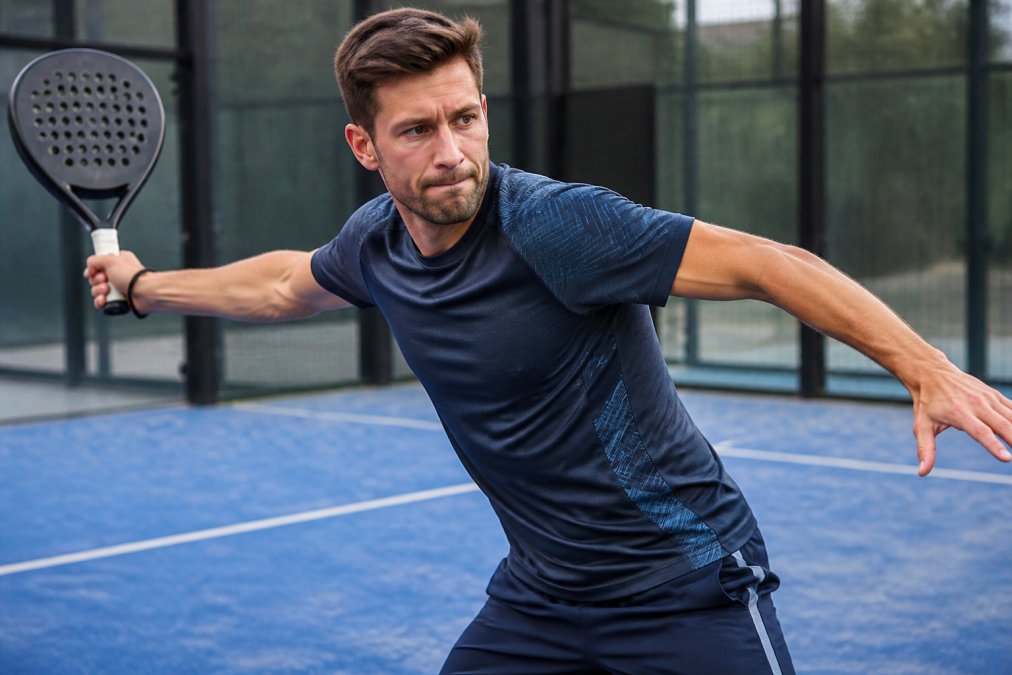
How a Performance Fit Should Look
Most guides tell you to buy your size and leave it there, which is not enough when you shop online. Use this guide to judge whether a shirt is cut for padel or just labelled sportswear.
Performance Fit vs Relaxed Fit: What You Will Feel
| Feature | Performance Fit | Relaxed Fit |
|---|---|---|
| Chest | Skims without compression | Hangs away from the body |
| Shoulder seam | Sits on the shoulder point | Drops past the shoulder |
| Sleeve length | Mid-bicep | At or below the elbow |
| Hem | Stays put during overheads | Lifts during overheads |
| Best for | Competitive and frequent play | Casual knockabouts and warm-ups |
If you play twice a week or more, performance fit is the better choice. If you are new and playing socially, a relaxed fit is comfortable and will not hold you back.
Structural Details That Separate Technical Shirts
Two structural details separate a technical shirt from a gym t-shirt:
- Raglan sleeves: the seam runs from the collar to the underarm rather than across the shoulder, removing the restriction point during overhead shots.
- Flatlock seams: stitched flat against the fabric instead of raised, the single biggest factor in chafing reduction during high-intensity training.
Why Athletic Builds Struggle With Standard Sizing
Players with broad shoulders and a narrower waist are the hardest to fit, and no single size chart solves that perfectly. Prioritise stretch and cut over exact measurement: a shirt with genuine 4-way stretch and raglan sleeves forgives a two-centimetre difference across the shoulders in a way a stiff cotton tee never will. When between sizes, size to your chest rather than your waist, and check the product page fit guide before ordering.
Key Features to Look For in a Padel Shirt
Use this checklist before you commit to any shirt. It takes thirty seconds and saves you from a wardrobe of gear that never quite works.
- Fibre blend of roughly 85-90% polyester with elastane for stretch
- 4-way stretch, not just two-way
- Flatlock seams at the shoulders and underarms
- Raglan or set-in sleeve construction that clears overhead movement
- Ventilation zones under the arms or across the upper back
- Anti-odor treatment, especially if you play back-to-back sessions
- Quick-dry finish, verified by the care label rather than marketing copy
- Lightweight construction that does not feel heavy when wet
| Mistake | What Happens | The Fix |
|---|---|---|
| Buying cotton for high-intensity play | Fabric soaks, clings, chills you between points | Switch to a polyester blend |
| Choosing on style alone | Restricts lateral movement | Prioritise 4-way stretch |
| Ignoring seam construction | Chafing under the arms | Look for flatlock seams |
| Sizing down for a tighter look | Pulls across shoulders on overheads | Size to your chest, not your waist |
| Skipping anti-odor finish | Shirt holds smell after one session | Choose treated fabric |
Third Shot vs Revive Activewear
The practical differences come down to this:
| Consideration | Third Shot | REVIVE Activewear and Apparel |
|---|---|---|
| Primary focus | Padel-specific tops | Padel tech plus multi-sport activewear |
| Cross-training use | Limited | Designed for padel, gym, running, yoga |
| Ordering scale | Single items | From one item to thousands for teams |
| Delivery | Standard | Standard or express options |
| Support | General | Dedicated expert team support |
One honest limitation: if you only ever play padel and want the widest choice of single-sport silhouettes, a padel-only brand may have more variety in that narrow lane. For everyone else, multi-sport is the better value.
How to Care for Moisture-Wicking Sportswear
The performance of moisture wicking padel shirts degrades with bad washing, the part almost every guide skips. The fibres are durable, but two things destroy them: fabric softener and heat.
- Wash cold, at 30°C or lower, on a normal cycle.
- Skip the softener entirely. Use a standard detergent, not a "softening" one.
- Turn shirts inside out before washing to protect the outer surface and any print.
- Avoid the tumble dryer. Hang to dry; technical fabric dries fast on its own.
- Wash after every session. Sweat left in the fabric feeds odour, even in anti-odor treated garments.
- Never iron a technical shirt. If it creases, the crease will drop out on the hanger.
Choosing the Right Size for On-Court Performance
Sizing for padel is about movement, not vanity. Measure your chest at its fullest point and your waist at its narrowest, then size to the larger number. If you are between sizes and play an aggressive, overhead-heavy game, go up rather than down.
Measure Before You Buy
You need two numbers: chest circumference and torso length. Measure chest around the fullest part, keeping the tape level under your arms, and torso from the base of your neck to your natural waist. Most online size charts use chest alone, so if your torso is longer than average, add one size to stop the hem lifting during overheads.
How Fabric Affects Your Size Choice
Different fibre blends behave differently on the body, which is where most sizing guides fall short.
The Athletic Build Problem
Players with broad shoulders and a narrower waist are the hardest to fit, and no single size chart solves that perfectly. Prioritise stretch over exact measurement: a shirt with genuine 4-way stretch and raglan sleeves forgives a two-centimetre difference across the shoulders in a way a stiff cotton tee never will.
Sizing for Different Play Styles
| Play Style | Recommended Fit | Why |
|---|---|---|
| Aggressive, overhead-heavy | True to size or size up | Room for shoulder rotation on smashes |
| Defensive, baseline play | True to size | Less restriction needed for lateral movement |
| Social, low-intensity | Relaxed fit acceptable | Comfort over performance |
| Competitive, twice weekly or more | Performance fit | Minimises distraction and fabric movement |
Check Reviews From Players With Your Build
Before you order, read reviews from players with a similar build. Look for comments about shoulder width, sleeve length, and whether the shirt rides up during play. A shirt that fits a 90-centimetre chest well may sit badly on a 105-centimetre chest, even in the same labelled size. If the product page offers a fit guide, use it alongside your measurements rather than instead of them.
Conclusion
The gap between a shirt that works and one that does not comes down to fibre blend, seam construction, and how you wash it. Get those right and you stop thinking about your clothing mid-rally.
Frequently Asked Questions
What is the best moisture-wicking shirt for men?
The best moisture wicking padel shirts for men use a polyester and elastane blend with flatlock seams, raglan sleeves and ventilation zones. Look for 4-way stretch, quick-dry technology and an athletic fit that allows lateral movement without riding up. Avoid heavy cotton, which holds sweat and weighs you down during high-intensity rallies.
How do I know if my shirt is moisture-wicking?
Check the label for terms like polyester blends, elastane or quick-dry technology. A simple test: place a drop of water on the fabric. If it spreads and evaporates quickly rather than soaking in, the shirt has hydrophobic properties. Moisture-wicking shirts also feel lighter when wet and dry within minutes after a match.
What features should I look for in a men's padel shirt?
Prioritise raglan sleeves for shoulder mobility, flatlock seams to reduce chafing, and ventilation zones under the arms or across the back. A 4-way stretch fabric with an athletic fit supports lateral movement. Also check for anti-odor treatment and a lightweight construction that stays comfortable across three sets.
How does fabric weight affect performance during a padel match?
Lighter fabrics, typically around 130 to 150 gsm, offer better breathability and quicker drying, which suits fast-paced padel rallies. Heavier fabrics above 180 gsm feel warmer and take longer to dry, making them better for cooler conditions or warm-ups. For most matches, a lightweight technical fabric with moisture transport properties keeps you cooler and drier.