 Ultimate guide
Eco Friendly Leggings for Sensitive Skin That Actually Work
Last Updated: November 9, 2026
Quick Summary
Eco friendly leggings for sensitive skin work best when fibre, dye, elastane content and seam construction all reduce irritation together. Choose breathable natural fibres for daily wear and check labels for chemical finishes, dyes and latex-free elastane. Flatlock or bonded seams and a wide soft waistband prevent friction.
- Cotton leggings need latex-free elastane and over 90% cotton content for reactive skin.
- Bamboo viscose is soft and silky but its antimicrobial claims are usually marketing, not proven.
- Check labels in order: fibre content, certifications, finish claims, then care instructions.
- Wash activewear inside out in cool water with fragrance-free detergent and skip fabric softener.
- Look for OEKO-TEX Standard 100 and GOTS certifications to verify eco and safety claims.
Table of Contents
- Eco Friendly Leggings for Sensitive Skin: What Actually Matters
- A Fabric-by-Fabric Decision Framework for Sensitive Skin
- Organic Cotton Leggings for Eczema and Reactive Skin
- Bamboo vs Cotton Leggings for Sensitive Skin
- Identifying Irritants: What to Look For in the Label and Seams
- How to Verify Environmental and Skin-Safety Claims
- How to Wash Activewear for Sensitive Skin (and Keep It Breathable)
- Choosing Your Next Pair from REVIVE Activewear and Apparel
- Frequently Asked Questions
Eco Friendly Leggings for Sensitive Skin: What Actually Matters
Eco friendly leggings for sensitive skin are not simply leggings made from natural fibres. They are garments where the fibre, the dye, the elastane content and the seam construction all work together to reduce irritation while still surviving a workout. A common mistake is to buy "natural" and assume the itching stops.
It often doesn't. A review in Materials on functional clothing and skin health notes that antimicrobial and eco-friendly claims for bamboo clothing are frequently marketing statements rather than proven skin outcomes. The fibre is only one variable.
Below, we break down the fabric trade-offs, the specific irritants to hunt for on a label, and how to wash activewear so it stays breathable.
A Fabric-by-Fabric Decision Framework for Sensitive Skin
Start with the fibre, then check the elastane, then check the seams. That order matters because a perfect organic cotton blend with a stiff exposed seam will still rub a reactive waistline raw.
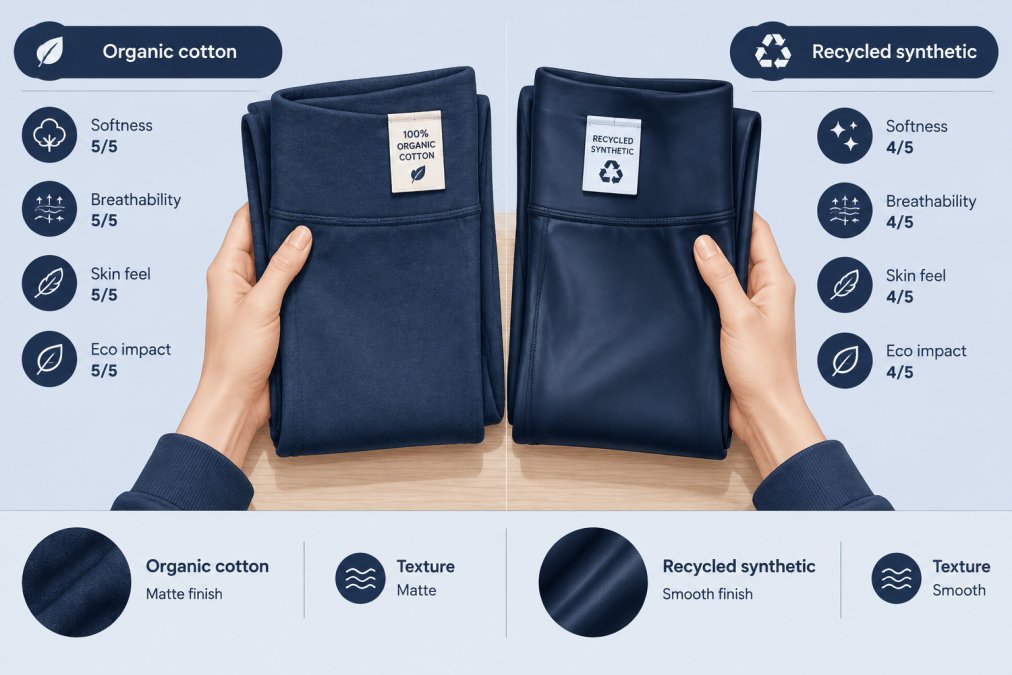
The table below is a general starting point, not a verdict. Use the notes underneath it to match each fabric to how your skin actually behaves.
| Fabric | Skin feel | Breathability | Stretch and recovery | Moisture handling | Likely trade-offs | Best for |
|---|---|---|---|---|---|---|
| Organic cotton | Soft, cool, low static | High | Low without elastane; moderate with 5-10% elastane | Absorbs well, dries slowly | Stretches out at knees and waist; heavier when wet | Eczema-prone skin, daily wear, gentle exercise |
| Bamboo viscose | Very soft, silky, cool | High | Moderate; can bag at pressure points | Absorbs well, slower to dry than synthetics | Pilling; antimicrobial claims are usually marketing, not proven outcomes | Everyday comfort, low-sweat days |
| Merino wool | Gentle, dry-touch, temperature-regulating | High | Moderate; fine gauge gives good recovery | Absorbs vapour, resists odour | Can felt or shrink if washed warm; costlier | Cooler conditions, long wear, travel |
| Recycled polyester | Smooth, slick | Moderate | High; holds shape | Wicks liquid sweat but can feel clammy in still air | Oleophilic, traps oils and odours; often needs anti-odour finishes | High-sweat training, compression |
| Recycled nylon | Smooth, supportive | Moderate | High; excellent recovery | Wicks well, dries fast | Similar oil-trapping issue to polyester; check for finishes | Yoga, studio classes |
How to Read the Table for Your Skin
If your skin reacts to heat and sweat, prioritise breathability and moisture handling over softness. Merino and bamboo viscose move vapour well; recycled polyester wicks liquid sweat but can feel clammy when you stop moving. A common pattern is that reactive skin tolerates a wicking synthetic during exercise but flares during the cool-down, so consider a looser fit or a change of garment afterwards.
If your skin reacts to friction, softness and seam construction matter more than fibre. Bamboo viscose and fine merino have the lowest surface friction in this list, but a bonded seam in recycled nylon will often beat an overlocked seam in organic cotton. Fibre is only half the equation.
If your skin reacts to chemical finishes, the fibre tells you less than the finish does. Cotton and wool are less likely to need anti-odour treatments, but they can still carry dyes and softeners.
If you need compression or shape retention, synthetics win on recovery, but look for latex-free elastane and a smooth inner face. Compression garments concentrate pressure and friction at seams, so construction quality matters more here than in a loose daily pair.
Natural Fibres vs Recycled Synthetics: The Real Trade-Offs
Natural fibres are often favoured for skin comfort and breathability. Recycled synthetics are often favoured for durability, shape retention and sweat management.
A practical compromise many sensitive-skin wearers land on is a natural-fibre daily pair and a synthetic technical pair for high-sweat sessions, rather than expecting one fabric to do everything. If you want to go deeper on the synthetic side, our guide to alternatives to synthetic activewear fabrics covers the material options beyond this shortlist.
Watch out: a fabric described as "breathable" on the label may still trap heat if the knit is dense or the garment is lined. Breathability is a property of the finished garment, not just the fibre.
Organic Cotton Leggings for Eczema and Reactive Skin
Organic cotton is often chosen by people with reactive skin, because it is breathable and absorbs moisture. Organic fibre can be certified, which gives you something to verify.
The catch is stretch. Cotton needs elastane to hold a high waist, and elastane is where latex-sensitive wearers run into trouble. Look for latex-free elastane and a cotton content above 90%.
A study in Sustainability on consumer behaviour toward eco-friendly clothing found that willingness to buy eco-friendly clothing is shaped heavily by perceived personal benefit, not just environmental concern. For sensitive skin, that personal benefit is comfort, and it is worth paying for.
Bamboo vs Cotton Leggings for Sensitive Skin
Bamboo and cotton leggings differ in feel: bamboo is often described as softer and silkier, while cotton is often described as cooler. Bamboo viscose drapes well and suits everyday wear.
If you want a third natural option, our guide to merino wool for workouts explains where wool fits for sensitive skin.
Identifying Irritants: What to Look For in the Label and Seams
The fastest way to find an irritant is to read the care label and turn the garment inside out. Most reactions trace to four things: chemical finishes, dyes, elastane and seam placement. None of them appear in the marketing copy.
Chemical Finishes, Dyes and Elastane: The Usual Suspects
Chemical finishes are treatments applied to fabric for moisture wicking, anti-odour or wrinkle resistance. They are the most common cause of contact irritation in activewear because they sit on the surface of the fibre, in direct contact with skin. A wicking finish is usually a polymer coating; an anti-odour finish may be a silver-based or antimicrobial treatment.
Dyes matter most for deep blacks and saturated colours, where more dye is used and more unfixed dye can remain. Low-impact dyes and dye-free options reduce the risk. If a garment is described as "dye-free" but comes in a colour other than natural or undyed, ask what is providing the colour.
Elastane is the stretch component, and the fibre percentage on the label tells you how much is present. Latex-free elastane may suit anyone with a latex sensitivity.
Seams and elastic cause friction and pressure rather than chemical reactions. Overlocked edges, exposed elastic at the waistband, and flatlock seams that sit proud of the fabric all create repeated rubbing at the same point. A common pattern is irritation along the waistband or inner thigh that appears after a few hours rather than immediately, that points to friction, not a chemical finish.
How to Read a Label for Irritants
Work through the label in this order:
- Fibre content. Look for the percentage breakdown, not just the fibre names. High elastane, high synthetic content and blended fabrics with no clear majority are harder to assess.
- Certifications. OEKO-TEX Standard 100 indicates the finished article has been tested for harmful substances (OEKO-TEX® STANDARD 100). GOTS covers organic fibre and processing. Neither guarantees your skin will not react, but they narrow the field.
- Finish claims. Words like "antibacterial", "anti-odour", "moisture-wicking" and "wrinkle-resistant" usually indicate a chemical finish. If your skin is reactive, these are the claims to interrogate.
- Care instructions. A garment that requires fabric softener or high heat is harder to keep skin-friendly over time.
Watch out: "antibacterial" and "anti-odour" are finish claims worth checking. If a label leads with those claims, check what is doing the work.
Fit and Construction Details That Cause Discomfort
Compression that digs, a high waist that rolls, and seams that sit proud of the fabric can all cause friction. Check three things before buying:
- Flatlock or bonded seams, not overlocked edges
- A wide, soft waistband with no exposed elastic
- A gusset seam positioned away from the inner thigh
Also check the rise and the leg length. A waistband that sits exactly on a fold of skin will rub with every step, and a seam that crosses the crease behind the knee will do the same. Try the garment on and move through a squat, a lunge and a seated position before committing, most friction problems show up in movement, not standing still.
How to Verify Environmental and Skin-Safety Claims
Verification matters for eco-friendly clothing. A "green" label is easier to trust with a certification behind it. Look for GOTS-certified organic cotton, OEKO-TEX Standard 100 for chemical safety, and clear fibre percentages on the label.
Be sceptical of vague language. "Eco-friendly" and "natural" are not regulated terms. For a broader view of what to check, see our guide to sustainable activewear options for eco-conscious women.
How to Wash Activewear for Sensitive Skin (and Keep It Breathable)
Wash activewear inside out in cool water with a fragrance-free, dye-free detergent, skip the fabric softener, and air dry.
Fabric softener can coat fibres and reduce breathability, so it is often best skipped on activewear.
Our complete guide to washing athletic clothing covers temperature, detergent choice and drying in more detail.
Choosing Your Next Pair from REVIVE Activewear and Apparel
REVIVE Activewear and Apparel provides activewear for men and women for gym, yoga, running and Padel tennis, with a focus on Padel tech designs. Ordering is available for any quantity, with standard or express delivery and dedicated expert support.
For sensitive skin, start with a high-waisted, flatlock-seamed pair and check the fibre content against the framework above. Browse the Revive Active Gym Full Length Leggings to see the construction for yourself.
Reactive skin and hard training do not have to be a compromise. Build your kit around the fibre, the seams and the wash routine, and the irritation usually follows. REVIVE Activewear and Apparel supports that with scalable ordering from a single piece to full team kits, standard or express delivery, and expert support to get sizing right first time. Get started with REVIVE Activewear and Apparel and train in gear that respects your skin.
Frequently Asked Questions
What fabrics are best for sensitive skin in activewear?
There is no single best fabric, only the best fit for your skin. Organic cotton is soft, breathable and often chosen by people with eczema or reactive skin, though it absorbs moisture and dries slowly. Bamboo and modal blends feel smooth and drape well, Recycled polyester and nylon manage sweat better for intense sessions. Try one fabric at a time and note how your skin responds over a week of wear.
Are synthetic leggings bad for sensitive skin?
Not automatically. Recycled polyester and nylon wick moisture and suit high-sweat sessions such as Padel or running, but tight synthetics trap heat and sweat against the skin if the fit is too compressive or the fabric lacks breathability. Microplastic shedding is also a genuine environmental concern with synthetic fibres. If you react to synthetics, look for a smooth inner face, flatlock seams and a latex-free waistband, and wash them after every wear to remove sweat and bacteria.
How do I know if my leggings are non-toxic?
Check the label for third-party certification rather than marketing language. GOTS certification covers organic status and restricts chemical inputs in processing; OEKO-TEX Standard 100 tests for harmful substances. Dye-free or low-impact dye claims should be stated specifically, not implied. Be sceptical of vague phrases like eco-friendly or non-toxic leggings with no standard named behind them. If a brand cannot tell you which certifier audited the fabric, treat the claim as unverified.
How should I wash activewear for sensitive skin?
Wash leggings inside out in cool water at 30°C or below, use a fragrance-free, dye-free detergent, and skip fabric softener, which coats fibres and reduces breathability. Wash after every wear, especially after sweaty sessions, and air dry rather than tumble drying to protect elastane.