 blog
7 Essential Workout Gear Items for Home Gym Beginners
Last Updated: October 25, 2026
Quick Summary
Home gym beginners need just four essential items to start: adjustable dumbbells or resistance bands for resistance, a yoga mat for floor work, a jump rope for cardio, and bodyweight exercises. These versatile pieces create endless workout possibilities without requiring expensive equipment or a fully stocked facility.
- Start with the budget tier below the one you think you need, such as the Minimal tier under £100 for complete beginners testing commitment.
- A yoga mat is 6-8 mm thick, resistance bands should stretch to roughly twice their length, and dumbbells should allow 12 clean reps with two left in reserve.
- One square metre of floor space, one wall hook, and one waist-height shelf hold a complete beginner setup of bands, adjustable dumbbells, a mat and a rope.
- Three full-body sessions per week for 30-40 minutes each builds a solid foundation, and beginners should train consistently for a month before upgrading equipment.
- Bands cost £20-40 for a set of five and train every major muscle group, while adjustable dumbbells covering 2-20 kg do the work of ten pairs of fixed weights.
Table of Contents
- Why Starting a Home Gym Makes Sense for Beginners
- Budget Home Gym Essentials: What You Actually Need
- Beginner Strength Training Equipment: Dumbbells and Free Weights
- Resistance Bands for Home Workouts: Versatility Without the Cost
- Small Space Home Gym Ideas: Making the Most of Limited Room
- The Right Activewear and Accessories for Home Training
- Building Your First Workout Routine at Home
- Frequently Asked Questions
Why Starting a Home Gym Makes Sense for Beginners
A home gym removes friction: no commute, no crowded peak hours, and you train whenever motivation strikes. For beginners, consistency beats intensity, a modest setup beats an expensive membership you abandon after three months.
Quality equipment costs far less than it did five years ago, and a few versatile pieces, dumbbells, resistance bands, a mat, create endless workout possibilities. Most beginners overthink this phase, believing they need a fully stocked facility. They don't.
People who start with essentials and add gradually stick with it longer than those who invest heavily upfront.
Budget Home Gym Essentials: What You Actually Need
When building a budget home gym for beginners, focus on tools that deliver the most variety for the least money: something for resistance, something for floor work, and something for cardio.
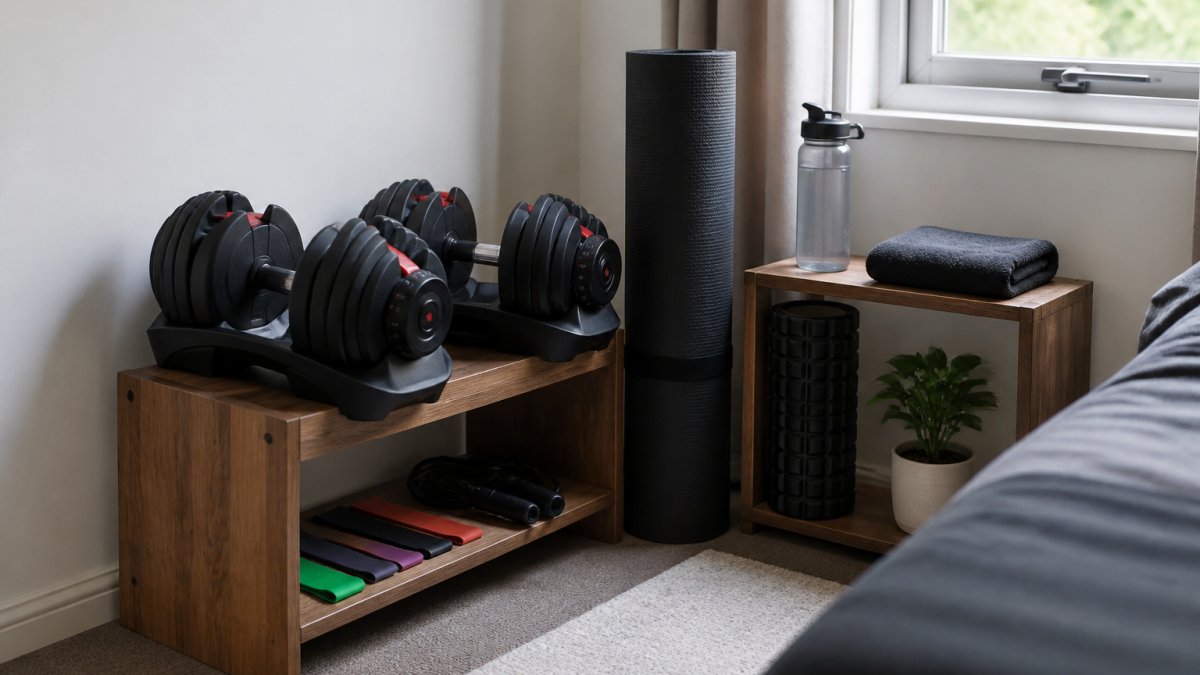
Start with adjustable dumbbells or fixed weights in the 5-15 kg range. A resistance band set costs less than a single pair of premium dumbbells but trains almost every muscle group.
Budget tiers work like this:
| Budget Level | Key Items | Best For |
|---|---|---|
| Minimal (under £100) | Resistance bands, yoga mat, bodyweight exercises | Complete beginners testing commitment |
| Starter (£100-300) | Adjustable dumbbells, bands, mat, jump rope | Serious beginners wanting strength + cardio |
| Expanded (£300-600) | Dumbbells, kettlebell, bench, bands, mat, accessories | Intermediate users ready to progress |
How to choose your tier without wasting money
The tier you pick should follow your training history, not your enthusiasm on the day you order. If you have not trained consistently for eight weeks, start at Minimal or Starter. The Expanded tier only makes sense once you can complete three full-body sessions a week for a month without missing one.
Within each tier, prioritise in this order:
- Floor protection first. A mat is the cheapest item and the one that prevents the most common beginner complaint, sore knees and a slippery floor during planks and lunges.
- Resistance second. Bands or dumbbells, whichever you will actually pick up. Bands are cheaper and quieter; dumbbells feel more like "real" training to most beginners.
- Cardio last. A jump rope costs under £15 and covers conditioning, so there is no reason to buy a machine before you know you will use it.
What you can skip (and do with bodyweight instead)
A beginner's first three months can be trained with nothing but floor space. Push-ups, squats, lunges, glute bridges, planks and inverted rows under a sturdy table cover every major movement pattern. Equipment adds value when it lets you progress, buy the dumbbell or band that adds resistance to a movement you have already mastered, not the machine that promises to teach you a new one.
Household stand-ins test commitment: a sturdy chair for split squats and triceps dips, a filled backpack for loaded carries, a towel for slider hamstring curls. Train consistently for a month with those and you have earned the right to spend.
Safety and fit when buying your first weights
Two mistakes cause most beginner injuries at home: starting too heavy and skipping the warm-up. Choose a dumbbell you can lift for 12 clean reps with two left in reserve, for most beginners, 5-8 kg per hand for pressing and 8-12 kg for rows and squats. A band should stretch to roughly twice its length without you losing posture; if you have to lean back to complete a row, it is too strong.
Check three things before you buy:
- Mat thickness. 6-8 mm is the practical range for home use. Thinner mats hurt on hard floors; thicker ones make balance work unstable.
- Band condition. Latex bands degrade and can snap. Inspect for nicks and store them out of direct sunlight.
- Dumbbell locking mechanism. On adjustable sets, test the collar or dial before every session. A weight that releases mid-rep is the single most dangerous failure mode in a home gym.
Buying used and making gear last
Home gym equipment is one of the better categories for buying second-hand, because the failure modes are visible. For dumbbells, check for cracks at the weld and rust eating into the handle.
Keep receipts and check the warranty before you buy. Adjustable dumbbells and benches commonly carry one to two years of cover, and a failed locking mechanism is exactly the kind of fault a warranty should address.
Beginner Strength Training Equipment: Dumbbells and Free Weights
Adjustable dumbbells are the single best investment for home gym beginners: they save space, reduce cost, and let you progress as you get stronger.
Fixed dumbbells in the 5-10 kg range work equally well if space and budget allow, cheaper per kilogram and no adjustment between sets.
Kettlebells add a different stimulus: the offset weight distribution forces stabiliser muscles to work harder than dumbbells do.
Barbells typically come later. Beginners rarely need them.
Resistance Bands for Home Workouts: Versatility Without the Cost
Resistance bands deliver exceptional value for home gym beginners. A set of five costs £20-40 and trains every major muscle group.
Use bands for upper-body pressing, pulling, leg work, and isolation exercises. Loop bands work best for lower-body movements; long bands with handles suit upper-body exercises.
The psychological advantage matters too: bands feel less intimidating than heavy iron, which helps beginners commit to consistent training.
Small Space Home Gym Ideas: Making the Most of Limited Room
Space constraints shouldn't stop you.
Vertical storage changes everything. Wall-mounted shelves hold dumbbells and bands. A pull-up bar in a doorway frame adds upper-body training without taking floor space. Fold-away benches disappear into corners when not in use.
The real secret: choose exercises that work in tight spaces. Bodyweight movements, push-ups, squats, lunges, planks, need only floor space. Bands anchor to a door handle or sturdy furniture, and dumbbells work in any room with a few metres of clearance.
Footprint: what each item actually takes up
Before you buy, measure the floor you are willing to give up permanently. A realistic guide for a beginner setup:
- Yoga mat: roughly 180 × 60 cm unrolled, but it stores rolled at about 15 cm diameter, the only item here that can live in a cupboard.
- Adjustable dumbbell pair: about 40 × 20 cm per dumbbell on a stand, so plan for a 50 × 50 cm corner.
- Resistance band set: a shoebox. Hang the loop bands on a hook and they take no floor at all.
A workable beginner footprint is roughly one square metre of floor plus a wall hook and a shelf. If you have less than that, bands and bodyweight are your whole programme, and that is a legitimate way to train for a year.
Noise: what neighbours will actually hear
The noise question is the one apartment dwellers ask most, and the honest answer is that it depends on the movement, not the equipment. Jumping, skipping and dropping weights transmit impact through the floor. Bands, dumbbell pressing, rows and floor-based core work are effectively silent.
Practical mitigations:
- Put a dense mat or interlocking foam tiles under the training area, this absorbs impact far better than a thin yoga mat.
- Replace jump rope intervals with low-impact cardio: step-ups, marching, band-resisted lateral walks, or a stationary bike if you have one.
- Lower weights to the floor under control rather than dropping them. This is good technique anyway.
Protecting floors and deposit
Rented floors and deposits are a real concern. Interlocking foam tiles (often sold in packs covering about one square metre) protect laminate and wood from dumbbell knocks and sweat. Avoid dropping kettlebells on any floor, the bell can crack tiles and the impact travels.
If you are in a furnished rental, check your tenancy agreement before mounting anything to a wall.
Portability and storage that actually works
The best storage is the kind you will use every session. A wall hook for bands and a waist-height shelf for dumbbells beat a cupboard, because gear you can see is gear you train with.
If you might move home or train in more than one room, weight portability heavily.
Apartment dwellers benefit most from bands and dumbbells because they're quiet. Low-impact cardio, steady-state band work, bodyweight circuits, or a jump rope on a mat keeps noise down while building fitness.
The Right Activewear and Accessories for Home Training
Moisture-wicking fabrics are essential. Synthetic blends and technical fabrics dry quickly and move with your body. Best moisture-wicking fabrics for intense workouts help you stay dry and comfortable through longer sessions.
Fit is personal. Look for comfortable activewear for long gym sessions that allows full range of motion without excess fabric.
Consider compression gear benefits as you progress. Compression doesn't magically improve performance, but many athletes report it aids recovery and reduces muscle soreness.
Accessories extend your gear's life. A small towel, water bottle, and basic foam roller complete your setup. Quality matters here too.
Building Your First Workout Routine at Home
Your first routine should be simple and sustainable. Three full-body sessions per week, 30-40 minutes each, builds a solid foundation.
A basic structure works like this:
- Warm-up (5 minutes): Light cardio or dynamic stretching
- Strength block (25 minutes): 3-4 compound exercises, 3 sets each
- Finisher (5-10 minutes): Light cardio or core work
Sample exercises for beginners:
- Dumbbell squats
- Push-ups or dumbbell chest press
- Dumbbell rows
Progression is built-in. Week one, use lighter weight and focus on form. Week two, add a rep or two.
Track what you do. Write down weights, reps, and how you felt.
Recovery matters equally to training. Sleep seven to nine hours, eat adequate protein, and take at least one full rest day weekly.
Frequently Asked Questions
What equipment does a beginner need for a home gym?
Start with adjustable dumbbells, resistance bands, a workout mat, and a sturdy bench or chair. These four items cover strength training, cardio, flexibility, and core work. Add a kettlebell or medicine ball once you're comfortable with basic movements. You don't need expensive cardio machines, bodyweight exercises and resistance work build fitness effectively. Prioritise quality over quantity; one set of adjustable dumbbells outperforms multiple fixed weights in a small space.
Can you build a home gym on a small budget?
Absolutely. Start with resistance bands (£15-30) and a yoga mat (£20-40), then add adjustable dumbbells (£50-100) as your main investment. Bodyweight exercises, push-ups, squats, lunges, cost nothing. Buy used equipment from online marketplaces to cut costs further. Many beginners see real progress with just these essentials. Avoid fancy cardio machines; they're expensive and take up space. Focus on versatile, multi-purpose gear instead.
How much space do you need for a beginner home gym?
A 2-metre by 2-metre area is enough to start. You need room to lie down, move your arms freely, and step back for lunges. Use vertical storage, wall-mounted racks or shelves, to keep dumbbells and bands off the floor. If space is very tight, resistance bands and bodyweight exercises are your best options. A yoga mat defines your workout zone and protects your floor. Many beginners train successfully in a corner of their bedroom or lounge.
What activewear should beginners wear for home workouts?
Choose moisture-wicking fabrics that keep sweat away from your skin, preventing discomfort and chafing. Fitted but flexible clothing lets you move freely without excess fabric getting in the way. Supportive trainers with good ankle stability help during strength work and cardio. Avoid cotton; it absorbs sweat and stays wet. Quality activewear combines performance with durability, so your gear lasts through months of regular training.
Starting a home gym as a beginner works best when you focus on essentials and build consistency. Equipment matters less than showing up regularly. REVIVE Activewear and Apparel supports your training with moisture-wicking activewear designed for home workouts, fast delivery options, and expert guidance on gear selection. Get started with quality apparel that keeps you comfortable and motivated through every session.