 How-to
How Do You Choose Running Gear for Changing Weather?
Last Updated: November 16, 2026
Quick Summary
To choose running gear for changing weather, dress for the start temperature, then plan to adjust. Use a moisture-wicking base layer, add removable mid and outer layers, and account for wind and rain, since they make conditions feel colder than the air temperature suggests.
- Dress for the start temperature, since you will warm up quickly once running.
- A windy 8°C day may need the same kit as a calm 4°C morning.
- Add one layer for every 15 to 20 mph of sustained wind on exposed routes.
- Wet fabric conducts heat away faster, so favour water-resistant shells over soaked mid-layers.
- Avoid cotton, which holds sweat and makes you feel cold once you slow down.
Table of Contents
- Why Changing Weather Makes Running Gear Harder to Choose
- What to Wear Running in Different Temperatures
- Running Clothes Layering Guide: Base, Mid and Outer Layers
- Running Gear for Rain and Wind
- Carrying, Removing and Adjusting Layers Mid-Run
- Running Gear Checklist for Changing Weather
- Booking Your Next Kit: Sizing, Fabric and Delivery Checks
- Frequently Asked Questions
Why Changing Weather Makes Running Gear Harder to Choose
Picking running gear is simple when the forecast stays the same all week.
The core problem is that your body changes while you run. You start cold, then warm up fast, and clothing that felt right at the start can feel wrong at the halfway point.
Here is the basic approach:
- Dress for the start temperature, then plan to adjust
- Choose layers you can add or remove easily
- Pick fabrics that manage sweat and dry quickly
Each step below breaks down one part of that process so you can make a confident choice before you leave the door.
What to Wear Running in Different Temperatures
Temperature is the first thing to check, but not the only factor. Wind chill, humidity, rain, sun and your effort all change how a run feels.
Use this table as a starting point, then apply the adjustments below:
| Temperature (approx.) | Typical Top | Typical Bottom | Extras |
|---|---|---|---|
| Above 18°C | Short-sleeve vest | Shorts or split shorts | Cap, sunglasses |
| 12°C to 18°C | Short or long sleeve | Shorts or light tights | Thin gloves optional |
| 5°C to 12°C | Long-sleeve base layer | Running tights | Light gloves, headband |
| Below 5°C | Base layer plus mid-layer | Thermal tights | Gloves, hat, buff |
| Below 0°C | Base, mid and outer layers | Thermal or windproof tights | Warm gloves, hat, neck cover |
These ranges are guidelines, not rules. A windy 8°C day may call for the same kit as a calm 4°C morning. Treat the table as a place to begin, then adjust for how you personally run and feel.
Adjusting the table for wind, rain and effort
A simple weather decision matrix is more useful than temperature alone. Read your forecast against these four inputs before you choose kit:
- Wind: Add the equivalent of one layer for every 15-20 mph of sustained wind on an exposed route. A 10°C morning with a 20 mph headwind on a coastal path can feel closer to 4°C, so a windproof shell earns its place even when the air temperature looks mild.
- Rain: Wet fabric conducts heat away far faster than dry fabric. In steady rain at 8°C, a water-resistant shell over a long-sleeve base layer beats a thicker mid-layer that soaks through. Light drizzle needs only a water-resistant layer; sustained heavy rain justifies full waterproofing.
- Effort and duration: A hard interval session generates far more heat than an easy recovery jog. For sessions under about 45 minutes at high effort, dress for what you will feel at minute 15. For long runs over 90 minutes, plan for the temperature to drop as your heat output falls.
Shoulder-season and warm-weather transitions
Winter clothing dominates most running-gear advice, but the trickiest conditions are often the swings between seasons. In early spring and late autumn, a single day can start near 3°C and finish near 13°C. The practical answer is removable layers rather than a single heavy piece:
- Shorts versus tights: Most runners switch to tights somewhere between 5°C and 8°C, but wind and personal tolerance matter more than the number. On a calm, dry 6°C day, shorts with a long-sleeve top are often comfortable; on a wet, windy 6°C day, light tights are the better call.
- Removable top layers: A long-sleeve base layer plus a packable windproof shell covers a wider temperature range than a single insulated jacket, because you can shed the shell once you warm up and put it back on if the wind picks up.
- Accessories as temperature controls: Gloves and a headband are the easiest layers to remove mid-run and stash in a pocket, start with them on a cold morning and shed them after 20 minutes.
Watch out: dressing for the forecast high rather than the start temperature is the most common shoulder-season mistake, you will be cold for the first 15 minutes and overheated for the rest of the run.
Running Clothes Layering Guide: Base, Mid and Outer Layers
Layering works because each piece has one job. The base layer manages sweat, the mid-layer holds in warmth, and the outer layer blocks wind and rain. For a deeper, winter-specific walkthrough, see winter layering for cold runs.
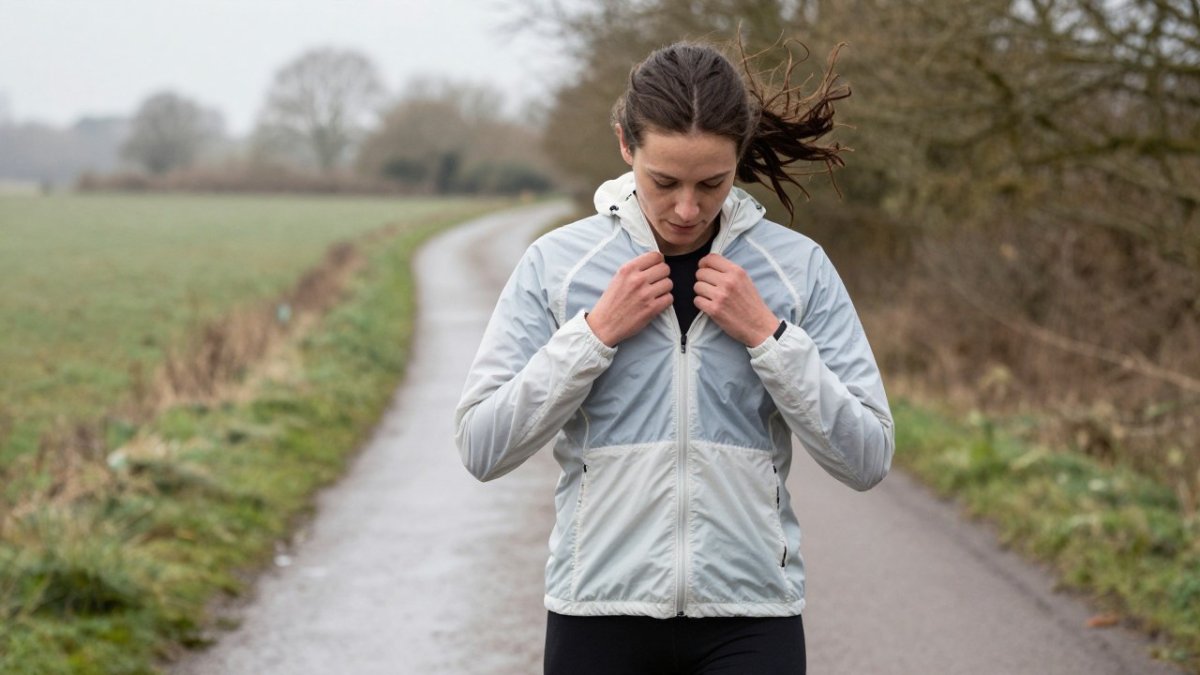
!Runner on a wet British path in early morning, wearing a fitted base layer, light mid-layer and windproof outer jacket, zipping up against the wind
Base layers and moisture-wicking fabrics
Your base layer sits against your skin, so its fabric matters most. Look for synthetic, moisture-wicking materials that pull sweat away and dry quickly. Read more about how merino wool performs for training in changing conditions.
Avoid cotton for running. It soaks up sweat, stays wet and makes you feel cold once you slow down. A fitted cut also helps, because loose fabric can bunch and chafe over a long run.
What to check on a base layer:
- Fabric labelled moisture-wicking or quick-drying
- A fit that sits close without restricting movement
- Flatlock seams to reduce rubbing
Insulating mid-layers and when to skip them
A mid-layer adds warmth, but it also adds bulk and sweat. Many runners wear one only when it is genuinely cold, roughly below 5°C, or when the wind is strong.
On milder days, skip the mid-layer and rely on the base layer and a windproof outer. You will often feel warmer than expected once you start moving, so overdressing is a common mistake, leave the mid-layer behind when conditions allow.
Running Gear for Rain and Wind
Wind and rain call for a different kind of protection. A windproof jacket blocks cold air, which matters a lot because wind chill can drop the felt temperature sharply.
Pay attention to the difference between water-resistant and waterproof. Water-resistant fabric handles light drizzle well. Full waterproofing suits heavy, sustained rain, though it tends to run warmer.
Practical features make a real difference:
- Taped or sealed seams in wet conditions
- Reflective details for low-light visibility
- Adjustable cuffs and hem to keep wind out
Keep your hands, ears and feet protected too, since wind and wet ground chill the body quickly.
Carrying, Removing and Adjusting Layers Mid-Run
Conditions can change during a single run, so the ability to adjust matters as much as the initial choice. Many runners start a little cold on purpose, knowing they will warm up within the first few kilometres.
Concrete ways to carry a shed layer
Removing layers is simple if you prepare for it, but carrying them without bouncing is where most runners come unstuck. These options work in practice:
- Tie around the waist: Knot the sleeves of a jacket or long-sleeve top at your front and let it sit on your hips. This works for light shells but is awkward for bulky or wet jackets.
- Running belt with a pocket: A slim waist belt with a zip pocket holds gloves, a headband or a thin cap. Some belts have a bungee cord that compresses a light shell against your lower back.
- Packable shell with its own pocket: Many windproof and water-resistant jackets fold into a chest or rear pocket and clip to a belt or waistband. Check the packed size before you buy, a shell that packs to the size of a fist is genuinely carryable; one that packs to the size of a football is not.
Avoid carrying layers you will not need. A heavy, bulky jacket becomes a burden after the first hour, so choose only what the forecast and your route genuinely require.
When conditions change mid-run
A decision guide for changing wind, rain and temperature during a single run is more useful than a fixed outfit plan. A common pattern is to reassess at three points: after the first 10 minutes, at the halfway point, and when you turn for home.
- If the wind picks up: Put on the windproof shell before you feel cold, not after. Once you are chilled, it takes far longer to warm back up.
- If rain starts: A water-resistant shell over a damp base layer is better than nothing, but if the rain is heavy and you are far from shelter, consider shortening the route rather than pressing on.
- If the temperature drops sharply: Add the mid-layer you packed and keep moving. Standing still in cooling conditions loses heat quickly.
Watch out: stopping for more than a few minutes in cold, wet conditions without adding a layer is when most runners get dangerously chilled, keep the stop short or put the shell on before you pause.
Safety in severe weather
Gear choices only go so far. Some conditions call for changing the plan rather than adding clothing:
- Lightning: If you can hear thunder, you are close enough to be at risk. Move to a building or a hard-topped vehicle and postpone the run. Open ground, hilltops and exposed coastal paths are the worst places to be.
- Ice and snow: Studded or aggressively treaded shoes help on packed snow and ice, but no shoe makes black ice safe. Shorten the route, choose cleared paths and run slower than usual.
- Heat: Above roughly 25°C, favour early-morning or evening runs, carry water, and choose light, breathable fabrics. Heat exhaustion is a real risk on long runs in direct sun (the NHS).
Running in changing weather rewards preparation. A few minutes spent checking conditions, packing sensibly and knowing when to change the plan makes each run more comfortable and safer.
Running Gear Checklist for Changing Weather
Use this checklist before any run when the weather is uncertain. It helps you cover the basics without overpacking.
- Check the temperature and wind chill, not just the air temperature
- Choose a moisture-wicking base layer for the start conditions
- Add a mid-layer only if it is cold or windy enough to need one
- Bring a windproof or water-resistant outer layer for exposed routes
Booking Your Next Kit: Sizing, Fabric and Delivery Checks
Once you know what to wear, the next step is buying gear that fits and performs.
Before you order, check the fabric composition, the fit notes and the delivery options on the product page. Pricing depends on quantity, dates and delivery, so check the REVIVE Activewear and Apparel website for current prices or a quote.
Good gear is an investment in every run, so take the time to get the fit and fabric right the first time.
Frequently Asked Questions
What should I wear for running in changeable weather?
Dress in three adjustable layers: a moisture-wicking base layer that keeps sweat away from your skin, a light mid-layer you can remove, and a wind- or water-resistant outer layer. Start the run feeling slightly cool, because your body warms up quickly once you are moving. Choose fabrics that dry fast, such as synthetic blends or Merino wool, and avoid cotton, which holds moisture and chills you when the wind picks up or rain arrives. Carry a lightweight jacket if the forecast is uncertain, and check the hourly forecast rather than the morning temperature alone before you head out.
Should I wear a waterproof jacket or a windproof running jacket?
A windproof running jacket is usually the better everyday choice. It blocks wind and sheds light drizzle, and it breathes well, so you are less likely to overheat during a steady run. A fully waterproof jacket keeps out heavy rain for longer but traps heat and sweat, which can leave you wetter from the inside. Choose a waterproof shell for prolonged rain, cold showers or exposed routes, and a water-resistant windproof jacket for mild, changeable British weather. Pack the waterproof option if the forecast is unsettled.
How can I avoid overheating when running in layers?
Start your run feeling a little cold, since you will warm up within the first 10 to 15 minutes. Unzip or remove your outer layer as soon as you feel warm, and tie it around your waist or carry it in a small pack. Keep your base layer breathable and moisture-wicking so sweat evaporates rather than pooling. On warmer days, skip the mid-layer altogether and choose a single light top with a windproof outer shell you can stow.