 How-to
How should you care for high-performance sports apparel?
Last Updated: October 24, 2026
Quick Summary
To care for high-performance sports apparel, wash within 24 hours of use in cool water with sports-specific detergent, turn garments inside out, and air dry completely in shade. Proper care preserves moisture-wicking properties, maintains breathability, and extends garment longevity so your investment lasts multiple seasons.
- Wash activewear within 24 hours of wearing to prevent sweat from embedding into fibers and degrading moisture-wicking properties.
- Use mild or sports-specific detergent at half the recommended dose, and avoid fabric softener, bleach, and standard heavy-duty detergent.
- Turn garments inside out before washing to protect outer performance finishes from friction and wear.
- Air dry completely in shade rather than tumble drying, which damages synthetic fibers and degrades elastic.
- Store in a cool, dry place and keep activewear separate from regular laundry to prevent lint transfer and odour cross-contamination.
Table of Contents
- Why proper care matters for high-performance sports apparel
- Check your care label before you wash
- How to wash sportswear correctly
- Best detergent for sportswear and what to avoid
- How to remove odour from gym clothes
- How to dry activewear without damaging performance features
- Fabric-specific care for technical finishes
- Extend the life of your activewear with proper storage
- Frequently Asked Questions
Why proper care matters for high-performance sports apparel
Buying quality gear is only half the battle, how you care for it determines whether it lasts one season or five.
The high-performance apparel market was valued at £11.45 billion in 2026, and for good reason Business Research Insights market valuation report.
Proper care preserves durability for repeated washing, maintains breathability and moisture management, and extends garment longevity so your investment pays off.
The stakes are real. Durability for repeated washing is among the most requested features for 2026 athletic apparel Impressions Magazine teamwear trends report.
Check your care label before you wash
Your garment's care label is not a suggestion. It's engineering documentation.
Read the label first. Every fabric blend, finish, and construction method has specific requirements.
Labels specify:
- Water temperature
- Wash cycle intensity
- Whether machine washing is safe at all
Taylor & Francis research on sports clothing quality found that experts define sports clothing quality by functional attributes like moisture management and durability.
Before you wash anything, check the label. If you've lost it, contact the retailer or manufacturer for guidance. Guessing costs money.
How to wash sportswear correctly
Washing high-performance sports apparel correctly means protecting the technical features that make it work. This isn't about being gentle, it's about being precise.
Wash soon after exercise
Sweat, salt, and bacteria begin breaking down fabric and finishes the moment you stop moving. Leaving damp activewear in a gym bag for hours accelerates this damage.
Wash your gear within 24 hours of wearing it. Ideally, within a few hours. The longer sweat sits on the fabric, the more it embeds into the fibers, making odor harder to remove later and degrading moisture-wicking properties.
This is the single most impactful step you can take.
Separate your activewear from regular laundry
Technical fabrics need different treatment than cotton T-shirts and jeans.
Wash activewear separately for three reasons:
- Regular detergent residue builds up on technical fabrics and blocks moisture-wicking
- Zippers and velcro on other garments snag and damage performance fabrics
- Lint from cotton transfers to synthetic fibers and clogs breathability
A dedicated wash load takes minutes longer but adds months to your gear's life.
Turn garments inside out
Turning activewear inside out before washing protects the outer surface where performance finishes live.
Moisture-wicking coatings, durable water repellent (DWR) finishes, and color dyes all sit on the exterior, where water, detergent, and washing machine friction wear them down faster.
Inside-out washing:
- Reduces friction on the outer finish
- Protects colour from fading
- Lets the inner surface (where sweat absorbs) face the detergent
Make this automatic. Turn it inside out, then wash.
Best detergent for sportswear and what to avoid
Standard laundry detergent will destroy your high-performance sports apparel.
Sports detergents work at lower temperatures and shorter cycles, engineered for synthetic fibres like polyester, nylon, and Lycra. Why Synthetic Fabrics Are Better for Running explains why these materials require specific detergent formulations.
Avoid these products entirely:
- Fabric softener (blocks moisture-wicking completely)
- Bleach (degrades synthetic fibres and dyes)
- Standard heavy-duty detergent (leaves residue)
Use half the recommended detergent amount. Technical fabrics need less soap than cotton. More detergent means more residue, which means worse performance.
ScienceDirect research on functional textiles shows that advancements in moisture-wicking and thermoregulation require proper maintenance to remain effective.
For Why Synthetic Fabrics Are Better for Running, understanding detergent choice is critical because synthetics respond differently to chemicals than natural fibres.
How to remove odour from gym clothes
Persistent gym odour is rarely a washing-frequency problem by the time it appears. It is usually a residue problem: detergent, fabric softener, and body oils build up in the fibre, trapping bacteria that keep producing odour compounds even after a wash.
Why technical fabrics hold odour
Synthetic fibres such as polyester are oleophilic, meaning they attract and hold oils. Learn about odour-resistant fabrics for endurance running to understand which materials naturally resist bacterial growth better than others. Those oils, plus dead skin cells and detergent residue, form a film inside the fibre where bacteria thrive. Merino resists bacterial growth naturally, but synthetics have no such defence, a polyester base layer can smell fresh out of the wash and develop odour within minutes of being worn again.
Step-by-step troubleshooting
Work through these in order. Stop as soon as the odour is gone.
- Strip residue build-up. Soak the garment for 30 to 60 minutes in cool water with a cup of white vinegar per wash load, or use a dedicated sports detergent designed to remove residue. Do not use hot water, which can set odour.
- Wash on a gentle cycle at 30°C or cooler with half the usual detergent dose. An extra rinse cycle helps flush residue from the fibre.
- Air dry fully in shade. Damp storage regrows bacteria quickly.
- If odour persists, repeat the soak with a specialist sports wash that contains enzymes targeting organic odour compounds. Follow the product's dwell time; most need 15 to 30 minutes of contact to work.
- If odour still persists after two cycles, the bacteria have colonised the fibre deeply. In that case, the garment may be at the end of its useful life for high-sweat activities; demote it to low-intensity use rather than continuing to wash it.
What not to do
- Do not use chlorine bleach on elastane or wool; it degrades the fibre and can yellow synthetics.
- Do not use fabric softener as a "freshness" fix; it coats the fibre and makes odour worse over time.
- Do not mask odour with scent boosters; they add another residue layer.
Prevention habits that actually work
- Change out of sweaty kit as soon as possible and hang it to dry before it goes in the laundry basket.
- Never leave damp kit in a gym bag or car boot; bacteria multiply fastest in warm, damp, enclosed spaces.
- Wash within 24 hours of use where practical.
If odour returns quickly even after a full strip-and-wash cycle, the garment's moisture-wicking finish may also be compromised. In that case, treat it as a sign to replace rather than continue treating.
How to dry activewear without damaging performance features
How you dry your gear matters as much as how you wash it.
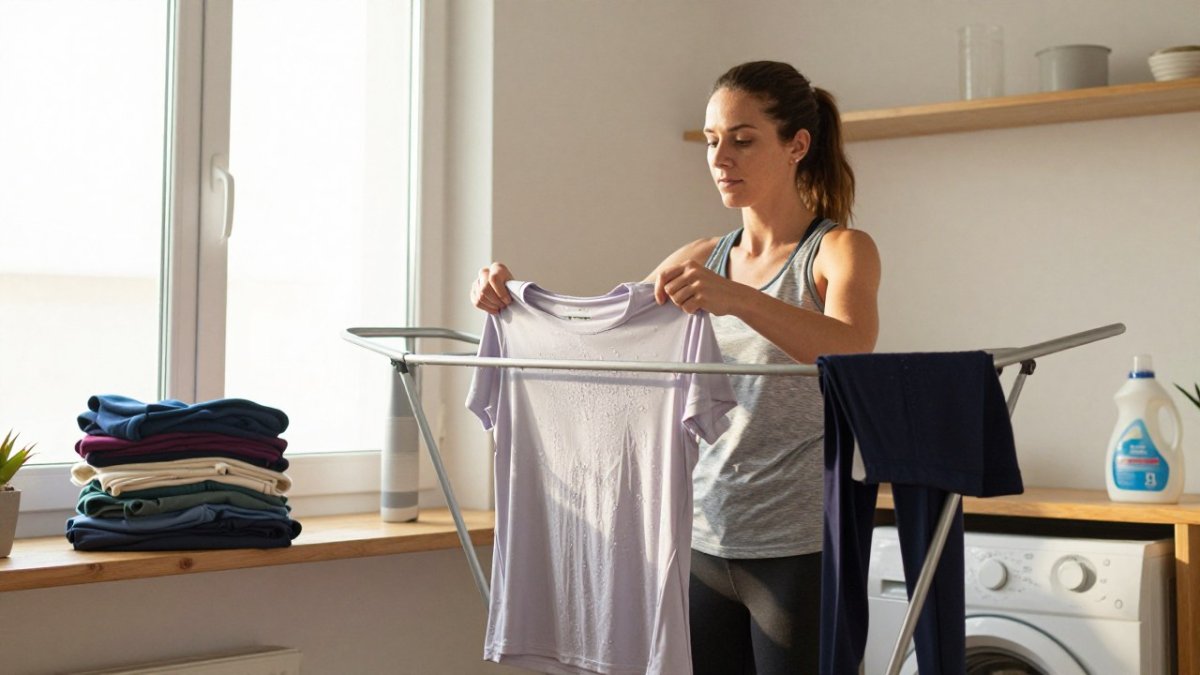
Air dry your activewear. Hang it on a clothesline or lay it flat on a clean surface.
Tumble drying applies heat and friction that:
- Damages synthetic fibres
- Degrades elastic and Lycra
- Reduces moisture-wicking properties
The only exception: if your care label explicitly allows tumble drying on low heat.
Drying takes 4-8 hours depending on fabric weight and humidity. Plan ahead. Don't rely on the dryer as a shortcut.
Ensure garments are completely dry before storing, residual moisture creates conditions for odour and mildew.
Fabric-specific care for technical finishes
Generic "wash cold and air dry" advice gets you most of the way, but the last 10% of performance comes from treating each fabric family on its own terms. Find your garment's dominant fibre on the care label, then follow the matching routine.
Polyester and polyester-elastane blends
Polyester is the workhorse of high-performance apparel: durable, quick-drying, and naturally moisture-wicking. Its weaknesses are oil retention (body oils and sunscreen cling to the fibre) and heat sensitivity.
- Wash at 30°C or cooler on a gentle or synthetic cycle.
- Use a mild liquid detergent at roughly half the dose you would use for cotton.
- Avoid biological powders with high enzyme loads on elastane blends, as repeated exposure can accelerate elastic fatigue.
Nylon and nylon-elastane
Nylon is lighter and smoother than polyester but more sensitive to heat and chlorine. If you swim in a nylon-elastane suit, rinse it in cool fresh water immediately after every pool session before chlorine attacks the elastane.
- Hand wash or use the most delicate machine cycle.
- Keep water below 30°C.
- Do not wring; roll in a towel and press out water.
Elastane (Lycra) and compression fabrics
Elastane is the most delicate component in any blend, degrading from heat, chlorine, fabric softener, and prolonged UV exposure. Compression garments lose their graduated pressure long before the fabric looks worn, so care directly determines how long they perform.
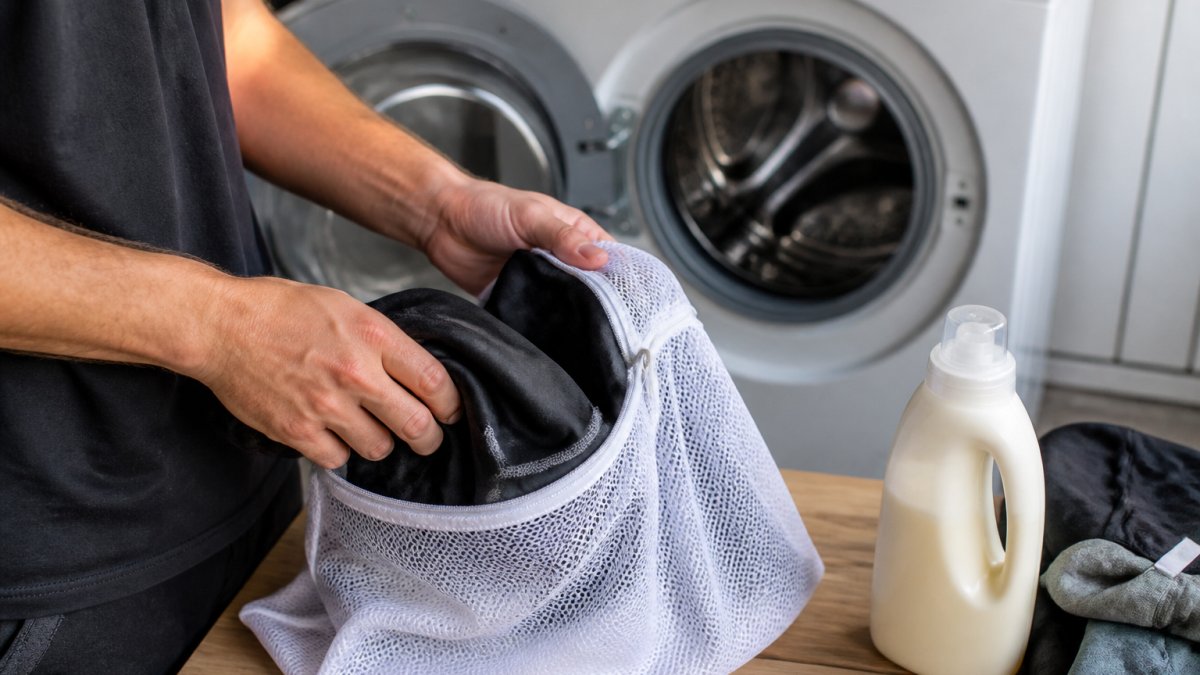
- Wash cool, inside out, in a mesh bag.
- Never use fabric softener or chlorine bleach.
- Air dry flat or hang in shade; never on a hot radiator.
Merino wool and wool blends
Merino is naturally odour-resistant and temperature-regulating, but it felts with heat and agitation.
- Use a wool-specific or pH-neutral detergent.
- Wash at 30°C or cooler on a wool cycle, or hand wash.
- Do not wring or tumble dry.
Waterproof and water-repellent membranes
Garments with a membrane (such as a laminate or coating) need the membrane protected, not stripped. Dirt and body oils clog its pores and reduce breathability, so regular washing is actually protective.
- Use a technical wash or pure soap, not standard detergent with optical brighteners.
- Wash at 30°C on a gentle cycle, rinse thoroughly.
- Do not use fabric softener or conditioner; it coats the membrane.
When to seek specialist care
Some items should not go in a domestic machine at all: heavily taped seams, down-filled technical jackets, and garments with bonded or glued construction. Check the care label and, if in doubt, use a specialist technical cleaner rather than risk delamination.
Extend the life of your activewear with proper storage
Store in a cool, dry place. Moisture and heat create conditions for bacteria and mildew.
Fold or hang activewear loosely. Tight storage creates creases that stress seams and elastic over time.
Never store damp or drying gear. Wait until it's completely dry.
Keep activewear separate from regular clothes.
Replace elastic and seams that show wear.
Caring for high-performance sports apparel isn't complicated.
| Care Step | Frequency | Impact |
|---|---|---|
| Wash after use | Within 24 hours | Prevents odour embedding |
| Use sports detergent | Every wash | Protects moisture-wicking |
| Turn inside out | Every wash | Preserves outer finishes |
| Air dry completely | Every wash | Extends fabric lifespan |
| Check care label | Before first wash | Prevents damage |
Frequently Asked Questions
How often should you wash sports clothes after exercise?
Wash high-performance sports apparel as soon as possible after exercise, ideally within a few hours. Sweat and moisture left on technical fabrics create an environment for odour-causing bacteria and can degrade the moisture-wicking properties that make the garment perform. Leaving damp apparel in a gym bag accelerates this damage. Prompt washing preserves both hygiene and the garment's functional lifespan.
Can you wash sportswear with ordinary laundry detergent?
No. Ordinary laundry detergents leave residue on synthetic fibres (polyester, elastane, Lycra) and can clog the fabric's moisture-wicking channels, reducing breathability and performance. Sports-specific detergents are formulated to clean without buildup. If ordinary detergent is all you have, use half the recommended amount and rinse thoroughly. For best results, invest in a mild sports detergent designed for technical fabrics.
Can high-performance sportswear go in the tumble dryer?
No. High heat from tumble dryers damages elastane, spandex, and durable water repellent (DWR) finishes, causing permanent loss of stretch and water-repellent properties. Always air-dry your activewear by hanging it in a well-ventilated space or laying it flat. Air drying preserves fabric integrity and extends garment longevity significantly compared to machine drying.
What is the best way to remove sweat odour from sportswear?
Wash garments immediately after use with sports-specific detergent in cool water on a gentle cycle. For stubborn embedded odours, soak the item in white vinegar (one part vinegar to four parts water) for 30 minutes before washing, or use an enzymatic sports detergent that breaks down sweat proteins. Ensure complete drying before storage, as moisture traps odour. Never use fabric softener, which masks odour temporarily but worsens buildup over time.