 How-to
5 Padel Court Positioning Rules for Beginners
Last Updated: November 3, 2026
Quick Summary
Padel court positioning is the habit of moving as a pair and staying in the right zone for each shot. Most points are decided by where you stand, so players who move together and cover their zones win more rallies.
- Move up and down together: when one player goes to the net, the other follows to the back.
- Learn the three zones: defence (red) near the back glass, transition (orange) in the middle, attack (green) near the net.
- Stand a short distance in front of the back glass, not flat against it, to avoid being pinned by a deep lob.
- Recover to the zone that matches the shot you just played, not to one fixed point on the court.
- Call the ball early and agree on coverage before the match to avoid collisions.
Table of Contents
- Why Padel Court Positioning Decides Most Points
- Step 1: Learn the Three Padel Court Zones
- Step 2: Set Your Padel Doubles Positioning as a Pair
- Step 3: Hold Your Padel Net Positioning When Attacking
- Step 4: Master Padel Defensive Positioning at the Back
- Step 5: Recover Your Position After Every Shot
- Common Positioning Mistakes Beginners Make and How to Fix Them
- Practise Your Positioning Before Your Next Booking
- Frequently Asked Questions
Most beginners lose points not because of their swing, but because of where they stand. Padel is a doubles game, and your court position decides who reaches the ball and who gets caught flat-footed. Get positioning right and your shots get better, your rallies last longer and your partner stops shouting at you. This guide walks through five rules to help you start.
Padel court positioning is the habit of moving as a pair and staying in the right zone for each shot. It sounds simple, yet most club players skip it entirely and chase the ball around the court. The rules below are practical, and you can try them in your next session.
Why Padel Court Positioning Decides Most Points
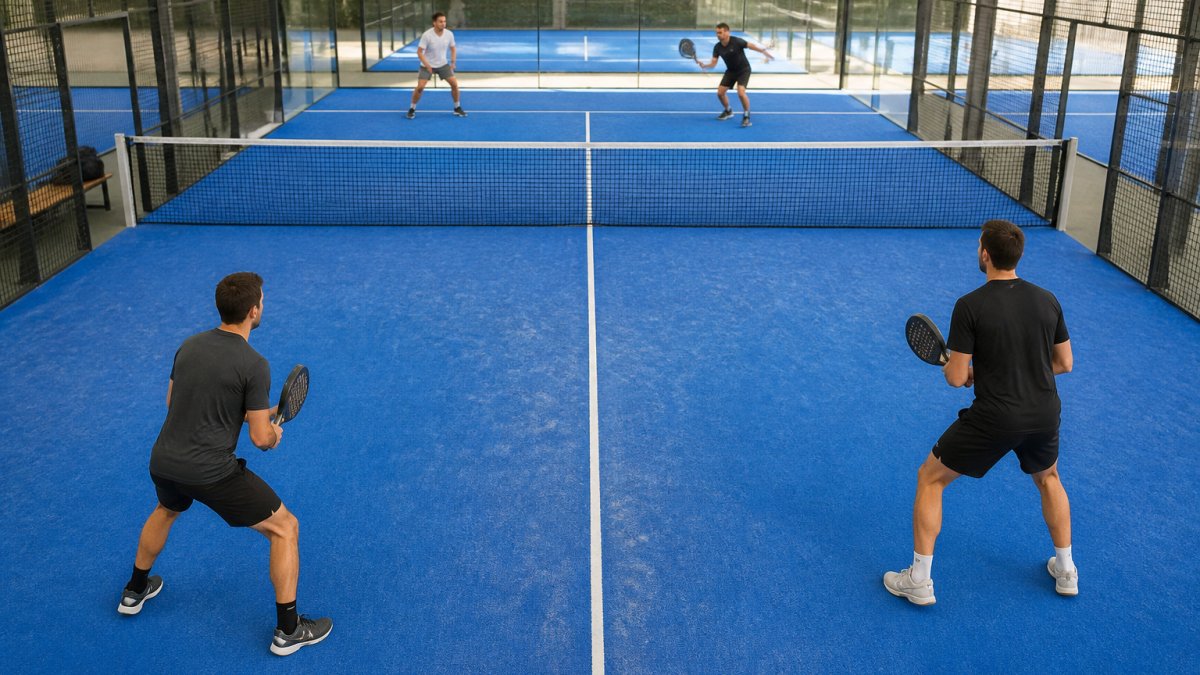
The key idea is coordination. Two players at the net can cover most of the court, but only if they move together. When both players drift to the same side, the gap in the middle becomes an easy target for opponents.
Good positioning also saves energy. You spend less time sprinting when you already stand near the ball's likely path. Over a full match, that difference adds up.
Expect your first few sessions to feel awkward. Standing in the "wrong" spot will feel natural at first, and that is normal. Stick with the habit and it becomes automatic.
Step 1: Learn the Three Padel Court Zones
Before you move, learn the three zones of the court. Coaches often use colours to make them easy to remember.
- Defence zone (red): the area near the back glass, where you hit from when you're under pressure
- Transition zone (orange): the middle area, where you move between attack and defence
- Attack zone (green): the area close to the net, where you press for winning shots
Most points are decided in these zones. Beginners who understand them make fewer unforced errors. Spend a few minutes each session checking which zone you're in before each shot.
Step 2: Set Your Padel Doubles Positioning as a Pair
Doubles works best when you and your partner act as one unit. A simple rule is to move up and down together. If one player goes to the net, the other should follow to the back, and the reverse is also true.
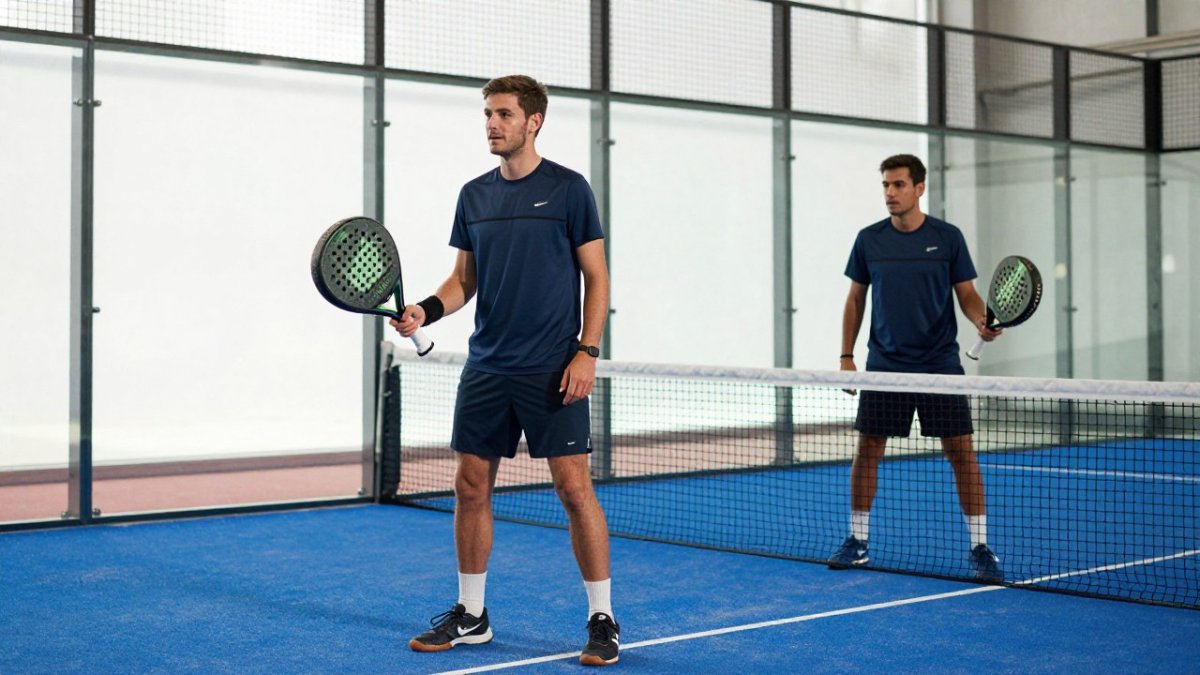
Keep a comfortable distance between you. Our guide on moisture wicking padel shirts for men explains how to stay dry while moving as a pair. Staying a comfortable distance apart, then adjusting to the flow of the rally, helps. If you're too close, you leave gaps. Too far apart, and the ball slips through the middle.
Share the coverage clearly. Call the ball early, say "yours" or "mine," and agree who takes the centre. Silence causes most collisions on court.
Step 3: Hold Your Padel Net Positioning When Attacking
When you attack, your job is to win the point at the net. Stand a short way behind the net line, then step forward when the ball comes to you high. Standing too far back gives your opponents time to recover.
Once you reach the net, stay balanced with your knees bent and racket ready. Keep your hands in front of your body. Watch the opponent's racket, not just the ball, because it tells you where the shot is going.
Watch out: beginners often rush to the net before their partner gets there. Move forward only when your partner is level with you, or you'll leave the back of the court wide open.
Step 4: Master Padel Defensive Positioning at the Back
When your opponents hold the net, you defend from the back. The mistake beginners make is treating the back of the court as one flat zone. It is not. Your depth at the back should change with the shot coming at you, and the back glass is a tool, not a wall you stand against.
Start a short distance in front of the back glass, not touching it. That gap gives you room to step back into a lob and to play a ball that has rebounded off the glass. If you stand flat against the glass, a deep lob pins you and you have no swing. Your partner should hold the same depth on the other side so the pair stays level.
Read the glass before the ball arrives. A ball that hits the back glass and comes out low and fast needs you to stay low and open the racket face; a ball that comes out high and slow gives you time to step in and drive it. Turn your shoulders early and watch the ball off the glass rather than the opponent's racket once it has passed you. Most beginners watch the hitter and are surprised by the rebound.
Use a split-step as your opponent strikes. A small hop and landing on the balls of your feet as their racket meets the ball lets you push off in either direction. Without it, you are flat-footed when the lob goes up, and the lob is the shot that beats back-court pairs most often.
Defence is not passive, but it is patient. Aim deep and central rather than for the corners: a deep ball to the middle forces the net pair to hit from the back and buys your partner time to move forward. Chasing a low-percentage winner from the back is how beginners donate points. The goal from the back is to survive one more ball and turn defence into attack when the opponents' shot sits up.
Watch out: if you and your partner both drift to the same side at the back, the cross-court lob beats you every time, so agree before the point who covers the middle and who takes the glass side.
The article's defensive guidance can be scanned quickly by problem, cause and fix.
| Shot or problem | Cause | Fix |
|---|---|---|
| Deep lob pins you | Standing flat against back glass | Start a short distance in front of the glass |
| Ball off the glass low and fast | Standing too high or not opening racket face | Stay low and open the racket face |
| Ball off the glass high and slow | Misreading the rebound | Step in and drive the ball |
| Lob beats you | Lack of split-step as opponent strikes | Split-step on the balls of your feet |
| Cross-court lob beats pair | Both players drift to the same side | Agree who covers the middle and the glass side |
| Losing points from the back | Chasing low-percentage winners | Aim deep and central to survive one more ball |
Step 5: Recover Your Position After Every Shot
Recovery is where beginners often lose points. The problem is not that players forget to move; it is that they do not know where to move to, because the correct recovery spot depends on the shot they just hit. "Back to the middle" is only half true.
After a lob from the back, do not sprint to the net. Hold your depth, let the lob do its work, and move forward only as far as the transition zone while your partner also steps up. If you charge the net after a lob, a good opponent plays a short ball at your feet and you are stuck in no-man's land, the strip between the service line and the net where you can neither volley comfortably nor retreat in time.
After a bandeja or a high volley from the net, recover one step back towards the service line rather than staying flat against the net. That half-step gives you time to react to a counter-lob and keeps you balanced if the ball comes back low. After a chiquita, the low ball played to the net player's feet, the hitter should recover towards the middle of the court, because the reply is usually a lob over their head.
After a defensive ball from the back glass, recover to your base depth off the glass and re-set your split-step. Do not drift forward hoping to intercept; the net pair will lob you.
The mechanism that makes recovery work is the split-step on your opponent's contact. Recover to your base spot, then hop and land as they hit. That single habit turns recovery from a scramble into a reset. A common pattern among club players is to recover too far forward after an attacking shot and too far back after a defensive one; the fix is to recover to the zone that matches the shot you just played, not to a single fixed point.
Watch out: if you recover to the exact centre of the court every time regardless of shot, you will spend the rally in no-man's land, so recover to your side's base spot and let your partner cover theirs.
Common Positioning Mistakes Beginners Make and How to Fix Them
Most beginners make the same few errors. Here are the common ones and how to fix them:
- Both players at the net: Keep one player back to cover lobs.
- Both players at the back: Move up together when you get a chance to attack.
- Standing in the middle of the court: Choose a side and cover it properly.
- Forgetting to recover: Return to the centre after every shot.
- Silence on court: Call the ball early and agree on coverage before the match.
Film a short session on your phone if you can. Watching your own movement is one of the fastest ways to spot these habits.
Practise Your Positioning Before Your Next Booking
Positioning improves with practice, not just reading. Before your next court booking, spend ten minutes on a simple drill. Serve or rally with your partner, and call out each zone change as you move.
Comfortable kit makes practice easier. We design REVIVE Activewear and Apparel for the movement padel demands, so you can focus on your footwork rather than your clothes. Subscribe to our email list for more tips, and tell us which rule you're working on first.
Frequently Asked Questions
Where should beginners stand on a padel court?
Beginners usually stand in one of two positions with their partner: up at the net when attacking, or towards the back of the court when defending. For attacking, standing a short way behind the net is the usual starting point. When defending, move back towards the rear glass, staying close to your partner so you cover the court together rather than leaving a gap down the middle.
What are the three zones of a padel court?
Babolat's tactical guide divides the court into three zones: a red defence zone at the back, an orange transition zone in the middle, and a green attack zone at the net. Beginners should learn to recognise which zone they are in on each shot, because the zone usually tells you whether to stay back, move forward or prepare to recover. Moving through the transition zone quickly is one of the most common changes beginners need to make.
Should both players move together in padel?
Yes. Beginner guidance from The Padel School and Padel39 both stress moving as a pair. Each player covers roughly half the court, and when one player moves up or back, the partner should shift with them to keep the team shape. PadelPark suggests keeping a working distance of about three to four metres between partners, adjusting it as the rally develops.
Where should you stand when defending in padel?
When defending, stand near the back of the court, close to the glass, with your partner beside you rather than far away. Keep the ball in front of you and move towards the centre to cover a straightforward shot, since leaving the middle open is a frequent beginner error. Once you have control of a defensive ball, use the time to move back into your defensive position.