 How-to
Should You Wear Compression Gear After Surgery?
Last Updated: October 26, 2026
Quick Summary
Compression gear after surgery applies steady, even pressure to limit fluid buildup, support healing tissues and reduce swelling, with the best evidence for less swelling and bruising after rhinoplasty. Wear time depends on your procedure and surgeon's instructions, commonly about six weeks to three months. Garments should feel firm and even, never painful, numb or cold.
- A 2023 review found the best-supported uses are less swelling and bruising after rhinoplasty.
- Common wear guidance runs from about six weeks to three months, so follow your surgeon's plan.
- Stop and contact your care team if skin turns cold, pale, blue or numb.
- Wash garments after every one or two wears and keep a spare in the same size.
- Confirm with your care team whether the garment goes over or around any dressing or drain.
Table of Contents
- What Compression Gear Does After Surgery
- How Long to Wear Compression Garments After Surgery
- How Tight Should Compression Garments Be After Surgery?
- How to Put On a Compression Garment After Surgery
- Compression Garment Care After Surgery
- Choosing Compression Gear That Works While You Recover
- Check Your Surgeon's Instructions Before You Buy
- Frequently Asked Questions
What Compression Gear Does After Surgery
Compression gear after surgery works by applying steady, even pressure to the treated area, which is why so many patients ask about compression gear after surgery.
The strongest proof sits in one specific place. A 2023 practical review found that the best-supported uses of postoperative compression garments are reducing swelling (oedema) and bruising (ecchymosis) after rhinoplasty, according to the review of postoperative compression garments.
That is a narrow claim. It does not cover every operation.
The Best-Supported Benefits
The clearest wins are less swelling and less bruising. Compression therapy applies gentle pressure that helps move excess fluid away from the surgical area. It also supports the healing tissues around an incision.
Surgeons often recommend compression for these reasons:
- Reduced swelling around the treatment area
- Less bruising as fluid clears
- Support for healing tissues and the incision
Where the Evidence Is Weaker
Here is the part most guides skip: the proof is not equal across every procedure. The same 2023 review stresses that benefits are procedure-specific. Broad claims that compression helps every plastic surgery equally are not backed by strong evidence.
So treat compression as a tool with real but limited proof. Ask your surgeon what applies to your operation.
How Long to Wear Compression Garments After Surgery
There is no single answer, because wear time depends on your procedure and your surgeon's instructions. For practical guidance on compression leggings for recovery, including wear duration and usage, see our guide.
Newer research is testing whether shorter is fine. A 2026 study reported that patient comfort was significantly better with shorter wear duration, while aesthetic satisfaction was similarly high across all groups at 12 months, per the 2026 compression duration study.
That is good news for anyone dreading months in tight garments. But do not cut your wear time on your own. Ask your surgeon first.
How Tight Should Compression Garments Be After Surgery?
Compression garments after surgery should feel firm and snug, but never painful. You want even pressure across the treatment area, not pinching or numbness. If a seam digs in or your skin goes cold or tingles, the fit is wrong.
Why "Firm but Not Painful" Is the Right Target
Postoperative compression works by applying graduated pressure, firmest at the part of the limb furthest from the heart and easing as it moves up. That gradient is what helps move excess fluid away from the surgical area rather than trapping it.
Most practitioners find that the correct feel is best described as "firm handshake" pressure: noticeable, even, and comfortable enough that you forget about it within a few minutes of putting it on.
A Staged Fit Check You Can Do at Home
Use this check in the first hour after putting the garment on, then again at the end of each day. Work through it in order, if you fail any step, stop and act on it.
| What to check | Good sign | Warning sign | What to do |
|---|---|---|---|
| Pressure | Firm and even | Sharp pain, pinching or a deep seam line | Reposition the garment; if it persists, remove it and contact your care team |
| Skin colour | Normal for your skin tone | Cold, pale, blue, dusky or blotchy | Remove the garment and seek advice the same day |
| Sensation | Comfortable | Numbness, tingling or "pins and needles" | Remove the garment and contact your care team |
| Swelling | Settling or stable | Sudden increase, hardness or tightness below the garment | Remove the garment and seek urgent advice |
| Skin surface | Intact | Redness, blistering, weeping or broken skin | Stop wearing it over that area and contact your care team |
| Temperature | Warm and normal | Hot, or you feel feverish | Seek medical advice, this is not a fit issue |
Recognising Excessive Tightness
Excessive tightness rarely appears as one dramatic symptom. A common pattern is a garment that felt fine on day one and becomes progressively harder to tolerate as swelling peaks, usually in the first week. Watch for:
- Indentations that do not fade within 20-30 minutes of removing the garment
- A cold foot or hand compared with the other side
- Numbness or tingling that was not there before
If you notice any of these, take the garment off, note the time, and contact your care team. Bring the garment with you to your follow-up so they can check the fit and size.
When the Garment Is Uncomfortable or Unsuitable
Not every garment suits every body. If yours is uncomfortable, do not simply abandon compression, that can set back swelling control. Instead:
- Check the size against the manufacturer's chart, measuring as instructed rather than guessing.
- Try a different design, open-crotch styles, front-fastening bras, or garments with a lower compression class can make a real difference.
- Ask your surgeon or a fitter to confirm the compression class and size before you buy a replacement.
- Tell your care team about circulation or skin concerns before you continue wearing any garment. If you have a history of circulation problems, fragile skin, or a skin condition in the treatment area, get clinician guidance first.
What to Do If You Cannot Tolerate Compression at All
Some patients genuinely cannot tolerate a garment, because of sensory sensitivity, a skin reaction, or a wound that needs access. In that situation, compression is not abandoned; it is adapted. Your care team may suggest a different garment type, a lower compression class, intermittent wear, or an alternative method of managing swelling. The key point is that the decision belongs with your clinician, not with a general guide, including this one.
How to Put On a Compression Garment After Surgery
Putting on compression gear takes patience, especially in the first weeks. The goal is even pressure without twisting the fabric or straining your incision. Here is the step-by-step method we recommend:
- Check the garment for twists, seams or damage before you start.
- Sit down on the edge of a bed or chair to stay steady.
- Roll the garment down to the opening, like a sock.
- Slide your foot or arm in and ease it up gently.
- Unroll slowly so the fabric sits smooth and even.
- Smooth out creases that could press into your skin.
- Check the fit against the signs above before you move.
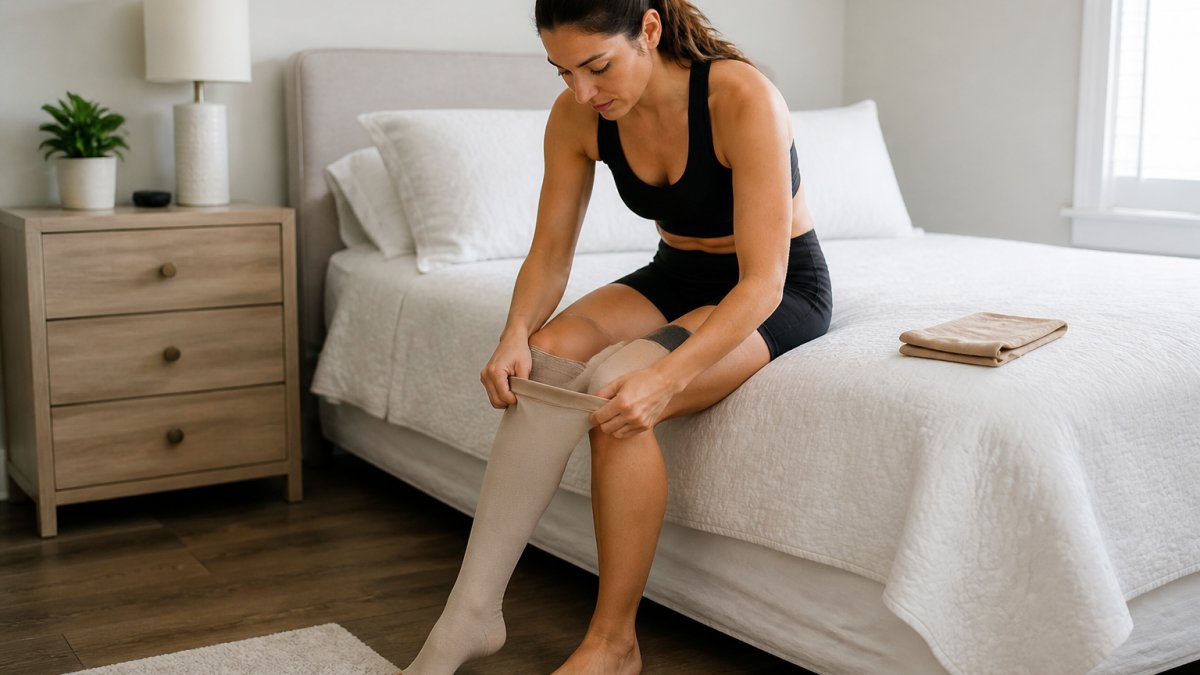
Open-crotch designs and front-fastening compression bras make this easier after breast surgery or lower-body procedures. Ask your surgeon which design suits your treatment area.
Compression Garment Care After Surgery
Clean garments compress better and last longer. Our activewear care guide explains how to keep activewear performing after repeated washing. Wash them regularly to keep the fabric's stretch and hygiene in good shape. Most compression wear needs a gentle, cool wash and air drying, so always check the label. Learn how to care for high-performance sports apparel so your garments keep working during recovery.
Why Care Matters More During Recovery
During continuous wear, a garment collects sweat, skin cells and residue from ointments or dressings. That build-up does two things: it reduces the fabric's ability to recover its stretch, and it creates a warm, damp environment against healing skin. Neither is what you want in the weeks after surgery. A common pattern is that patients who wash on a strict schedule report fewer skin complaints and a garment that still feels supportive at the end of the wear period.
A Simple Washing Routine
A few habits keep your gear working:
- Wash after every one or two wears, daily if you are wearing it day and night
- Use a gentle, cool cycle or hand wash, and a mild non-biological detergent
- Skip fabric softener, which coats the fibres and reduces stretch recovery
If your garment has hook-and-eye fastenings or Velcro, close them before washing to stop them snagging the fabric.
Managing Dressings and Drains
This is the part most guides skip. If you have a dressing or a drain in the treatment area:
- Ask your care team whether the garment goes over or around the dressing. Do not assume.
- Keep the garment off any drain site unless you have been told otherwise. A garment that presses on a drain can dislodge it or cause discomfort.
- Check the skin around the dressing each time you remove the garment, and report any redness, weeping or odour.
The Spare-Garment Rule
What most guides miss is the spare-garment rule. One garment means wash-day gaps in your compression. Two means you never break continuous wear.
A spare also gives you a fallback if a garment becomes soiled, stretched or uncomfortable. If your recovery plan calls for wearing compression day and night, a spare is not a luxury, it is part of the plan.
Day-and-Night Wear: Practical Hygiene
If you are wearing compression around the clock:
- Wash the garment in the evening and wear the spare overnight
- Check your skin at every change, morning and evening, for redness, irritation or broken skin
- Keep the skin clean and dry before putting the garment back on
Choosing Compression Gear That Works While You Recover
Fit and fabric matter more than branding. Look for even compression, smooth seams and a design that matches your treatment area.
What most guides miss is the spare-garment rule. One garment means wash-day gaps in your compression. Two means you never break continuous wear.
This is where REVIVE Activewear and Apparel helps. We offer quality activewear with an easy ordering process, from a single item to bulk orders for a team, plus standard or express delivery.
Check Your Surgeon's Instructions Before You Buy
Your surgeon's instructions beat any general guide, including this one. Wear time, compression level and garment design all depend on your procedure and how you heal. Bring your questions to your follow-up and get the plan in writing.
Before you order, confirm:
- The recommended wear time and compression level
- The right garment design for your treatment area
- When you can return to physical activity
Frequently Asked Questions
How long should you wear compression garments after surgery?
It depends on the procedure and your surgeon's plan. Many recovery plans run from around six weeks to three months, and a 2026 study reported that shorter wear duration gave significantly better patient comfort while aesthetic satisfaction was similarly high across groups at 12 months. Ask your surgeon for a specific end date, and never shorten or extend it on your own. If you are unsure, keep wearing the garment until your follow-up appointment and confirm the plan then.
Can you sleep in a compression garment after surgery?
Often yes, and many surgeons ask for continuous wear, including overnight, in the early weeks. Sleep is when swelling tends to settle, so the garment is doing useful work. The practical checks are comfort and skin: if the garment rolls, digs in or leaves deep marks overnight, refit it before bed. Keep a spare clean garment so you are not tempted to skip a night while one is drying.
What should you do if a compression garment causes pain or numbness?
Take it off and check the fit. Pain, numbness, tingling, colour changes or cold skin below the garment are warning signs that it is too tight or has slipped out of position. Reposition it, and if the symptoms return, stop wearing it and contact your surgeon or GP. A correctly fitted compression garment should feel firm and supportive, not painful, and you should be able to move and breathe comfortably in it.
How do you wash compression garments during recovery?
Follow the care label, usually a gentle machine wash at a low temperature with a mild detergent, no fabric softener and no tumble drying. Heat and softener damage the elastic, which is what provides the compression. Wash after each wear or two, dry flat away from direct heat, and keep at least one spare garment so you always have a clean one ready. Check seams and elasticity regularly and replace the garment if it starts to feel loose.
Recovering well starts with the right gear and the right guidance. REVIVE Activewear and Apparel offers quality products, an easy ordering process and dedicated expert support to help you reset and refocus. Get started with REVIVE Activewear and Apparel and find compression-friendly gear that supports your recovery from day one.