 How-to
7 Things to Know About Compression Socks for Standing All Day
Last Updated: October 29, 2026
Quick Summary
Yes, compression socks can help with standing all day, mainly by reducing lower-leg muscle fatigue and swelling. In a 2021 study, participants wearing 15-20 or 20-30 mmHg stockings through a 12-hour standing shift did not show the lower-leg changes seen in those wearing regular socks. Treat them as a support tool, not a cure for tired legs.
- For most standing workers, 15-20 mmHg is the sensible starting point for compression.
- Compression socks are sized by ankle and calf measurement, not by shoe size.
- Put socks on in the morning before your legs start to swell, and take them off when you get home.
- Never sleep in over-the-counter compression socks unless a clinician tells you to.
- Compression socks are not a treatment for plantar fasciitis and do not address heel pain.
Table of Contents
- Do Compression Socks Actually Help When You Stand All Day?
- What Level of Compression Do I Need for Long Shifts?
- How Tight Should Compression Socks Be?
- Can You Wear Compression Socks All Day?
- Compression Socks for Plantar Fasciitis: What to Expect
- A Practical Work-Shift Routine for Standing Comfort
- When to Avoid Compression Socks and What to Watch For
- Building Your Standing-Fatigue Kit with REVIVE
- Frequently Asked Questions
Do Compression Socks Actually Help When You Stand All Day?
Yes, compression socks can help, though the evidence is narrower than many product pages suggest. A 2021 study led by MG Garcia put participants through 12 hours of standing work. Those wearing regular socks showed clear changes in lower-leg measures. Those wearing compression stockings did not.
The tested stockings delivered 15-20 or 20-30 mmHg of pressure. Researchers reported the main benefit as reduced lower-leg muscle fatigue. That is a modest, specific gain, not a cure for tired legs.
Here is the honest framing. Compression socks are a support tool for long shifts. They are not a substitute for movement, good footwear or a decent mat. If you expect them to erase a 12-hour shift on concrete, you will be disappointed.
REVIVE Activewear and Apparel makes activewear for people who train and move through their day. If you want the wider picture of how compression gear works, read our guide to the benefits of wearing compression gear before you buy anything.
What Level of Compression Do I Need for Long Shifts?
For most standing workers, 15-20 mmHg is the sensible starting point. It sits in the mild range, it is easy to put on, and it is the level tested in the standing study above. But the number on the packet only means something if you understand what it measures and where it sits on the clinical scale.
Millimetres of mercury (mmHg) is a pressure unit (Health matters: combating high blood pressure). In compression socks, it describes the gradient the sock applies at the ankle, tapering upward. A 15-20 mmHg sock applies roughly 15-20 mmHg at the ankle and less at the calf.
Here is how the common ranges compare, with the clinical context most product pages leave out:
| Level | Pressure | Typical use | Clinical context |
|---|---|---|---|
| Mild | 15-20 mmHg | Long shifts, travel, first-time wearers | Often sold over the counter; suitable for everyday comfort and mild swelling |
| Moderate | 20-30 mmHg | Pronounced swelling, post-procedure recovery | Frequently recommended by clinicians; may need a fitting appointment |
| Firm | 30-40 mmHg | Chronic venous insufficiency, lymphoedema | Prescription or specialist fitting only |
| Extra-firm | 40+ mmHg | Severe venous disease | Prescribed and monitored by a clinician |
Independent reviewers have noted that the evidence on compression socks is mixed and advise checking with a doctor. That is fair. If you have a diagnosed circulation or vein problem, your clinician sets the level, not a product page.
For everyone else, start mild. Move up only if mild pressure leaves you wanting more, and only after checking your measurements against the brand's chart. Some people buy a firmer sock hoping for more relief, then find it harder to put on and warmer to wear. Where to start is best decided with a clinician, particularly before moving to firmer levels.
One practical test: if you can pull the sock on easily in the morning but it leaves deep marks by lunchtime, the fit is wrong, not the pressure level. Compression is about gradient and consistency, not brute tightness.
How Tight Should Compression Socks Be?
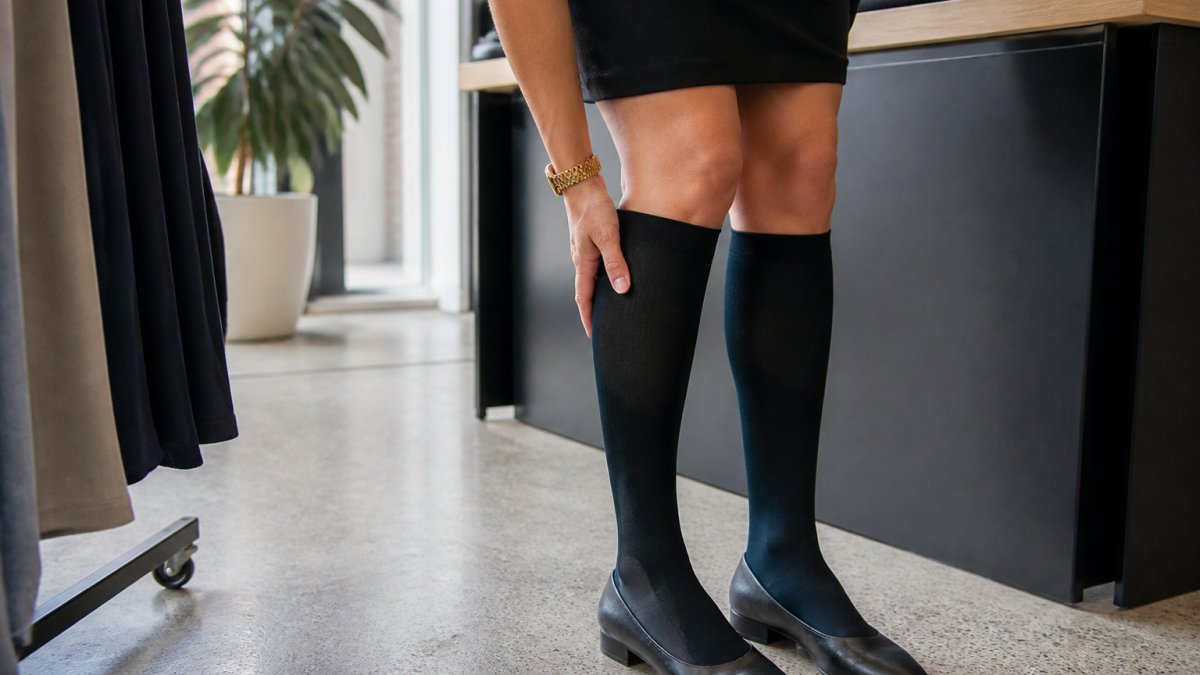
Compression socks should feel firm and even, never painful. You should feel steady pressure that eases from the ankle upward. That is what graduated compression means: highest at the ankle, lowest at the calf.
Three checks before you commit:
- No pinching. If a band digs in behind the knee, the fit is wrong.
- No wrinkles. Creases rub and cause skin irritation over a long shift.
- No numbness or tingling. Those are stop signals, not signs of "good compression."
A common mistake is sizing by shoe size. Compression socks are sized by ankle and calf measurement. Get a tape measure out and use the brand's chart. A sock that is too small will feel tight in the wrong places and cut off the very blood flow you are trying to support.
Can You Wear Compression Socks All Day?
Yes, most people can wear them through a full work shift. Put them on in the morning, before your legs start to swell, and take them off when you get home. That pattern suits daily wear well. But 'all day' deserves a more precise answer than that, because the evidence and the safety advice both depend on what kind of sock you are wearing and why.
The nuance sits in the word 'all day.' Prescribed stockings are fitted and monitored by a clinician, so how long they are worn is a clinical decision, while over-the-counter socks are generally designed for daytime wear. The context matters. A medical-grade prescription and a mild shop-bought pair are different products with different rules, different fitting requirements, and different evidence bases.
Here is a realistic framing of what the evidence supports for standing workers:
- Swelling and leg fatigue: The strongest evidence is for reduced lower-leg swelling and reduced muscle fatigue during prolonged standing. The 2021 study above found that people wearing compression stockings did not show the changes in lower-leg measures seen in people wearing regular socks over a 12-hour shift.
- Pain and performance: The evidence here is weaker and more mixed. Some people report less aching and heaviness; others notice no difference. Compression socks are not a performance enhancer for standing work in the way they are sometimes marketed.
- Prevention of long-term problems: Treat compression socks as a comfort and support tool, not a preventive medicine.
A practical timing routine for a standard shift:
- Put them on before you get out of bed or immediately after showering, while your legs are at their least swollen. If you wait until mid-morning, you are compressing an already-swollen leg, which is harder and less comfortable.
- Check the fit within the first hour. Look for wrinkles, pinching behind the knee, and numbness or tingling in the toes. Any of those mean the sock is wrong for you, not that you need to 'get used to it.'
- Keep them on through the commute and the shift. Walking in them is fine and helps circulation.
- Take them off when you get home, or at the end of your working day. There is no benefit to wearing them into the evening unless a clinician has told you otherwise.
- Inspect your legs after removal. Red marks that fade within an hour are normal. Persistent indentations, colour change, or skin that looks damaged are not, stop wearing them and speak to a clinician.
If you are weighing options for recovery as well as work, our piece on compression leggings for recovery covers where leggings fit and where socks do a better job. And if you are recovering from a procedure, our article on whether to wear compression gear after surgery explains why that decision belongs to your care team.
Compression Socks for Plantar Fasciitis: What to Expect
Compression socks are not a treatment for plantar fasciitis. They may ease the heavy, achy feeling that builds during a long shift, but they do not address the heel pain itself.
What actually helps plantar fasciitis:
- Supportive footwear with a firm heel counter
- Calf and foot stretching, done consistently
- Load management, so you are not standing still for hours on end
- A stress mat if your work surface allows one
If heel pain is your main complaint, treat the sock as one small part of a wider plan. Expecting a sock to solve it will cost you money and months.
A Practical Work-Shift Routine for Standing Comfort
Build the routine around your shift, not around the product. Here is a sequence that works for standing work.
- Morning: put socks on before you leave, while your legs are still fresh.
- Commute: keep them on. Walking in them is fine and helps circulation.
- Mid-shift: take a two-minute walk every hour. Socks support blood flow; they do not create it.
- Break: sit down and raise your legs if you can. Even a short elevation helps.
- After work: take the socks off, shower, and put your feet up.
- Evening: a short walk beats collapsing on the sofa for venous return.
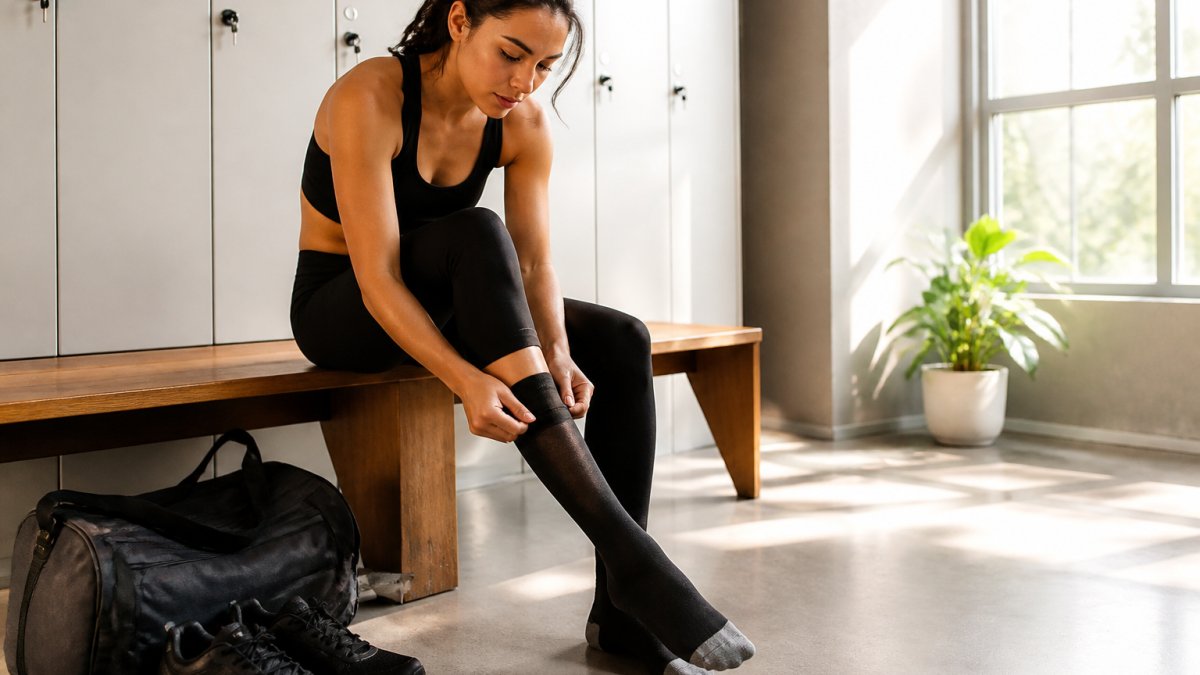
Footwear and a stress mat can matter as much as the sock. Readers building a standing-comfort routine may also want compression leggings for travel and long periods on their feet.
When to Avoid Compression Socks and What to Watch For
Compression socks are not for everyone. Skip them, or get advice first, if you have:
- Peripheral arterial disease or poor arterial circulation
- Heart failure or uncontrolled high blood pressure
- A skin infection or open wound on the leg
- Severe neuropathy or reduced sensation in the feet
- Diabetes with circulation complications
Stop wearing them and speak to a clinician if you notice numbness, tingling, colour change, increased pain, or shortness of breath. Those are not fit problems. They are reasons to get checked.
If you are recovering from a procedure, check with your care team before wearing compression gear.
Building Your Standing-Fatigue Kit with REVIVE
A sock alone will not carry a long shift. The kit does the work: compression, footwear, a mat, and the habit of moving every hour.
At REVIVE Activewear and Apparel, we make activewear for men and women, from gym workouts and yoga to running and Padel tennis. We offer easy ordering from a single item up to team quantities, standard or express delivery, and dedicated expert support. Start with the basics, then add what your shift actually needs.
Frequently Asked Questions
Do compression socks help with plantar fasciitis?
Compression socks can ease some of the swelling and achiness that comes with plantar fasciitis, but they do not treat the condition itself. The research on compression socks for plantar fasciitis is limited, and the main evidence for compression relates to circulation and leg fatigue during long periods of standing. If heel pain is your main issue, get a proper assessment and use compression as one part of a wider plan that includes footwear and stretching.
Should compression socks leave marks?
A light temporary mark that fades shortly after you take the socks off is normal. Deep grooves, numbness, tingling or skin irritation are not. Those signs mean the fit or compression level is wrong for you. Check your sizing against the manufacturer's chart, make sure there are no wrinkles in the fabric, and step down a compression level if marks persist. Persistent discomfort is a reason to speak to a pharmacist or GP.
Do compression socks reduce swelling after standing?
They can help. In a 2021 study led by MG Garcia, participants stood for 12 hours and showed altered lower-leg measures in regular socks but not in compression stockings at 15-20 or 20-30 mmHg. The authors linked this to reduced lower-leg muscle fatigue. Results vary between people, so treat compression as support rather than a guaranteed fix.
When should you avoid wearing compression socks?
Avoid compression socks if you have peripheral arterial disease, severe peripheral neuropathy, untreated skin infections on the leg, or a history of deep vein thrombosis without medical clearance. The same applies if you have heart failure or kidney disease that affects fluid balance. If you are unsure, check with your GP before wearing them for a full shift.
Standing all day is hard on your legs, and the right gear makes it easier to keep going. REVIVE Activewear and Apparel offers functional activewear with Padel tech design, scalable ordering from one item to thousands, and express delivery when you need it fast. Get started with REVIVE Activewear and Apparel and build a kit that keeps you comfortable from the first hour to the last.